Pushing agenda

This piece is community funded. If you like this article, please consider supporting my writing by visiting my Patreon and becoming a patron.

Last week Unwinnable featured an interview with Stephanie Anne, Editor-in-Chief of Goodgamers, more or less as a briefing on what to expect from the brand new outlet. Despite the site’s youth it harbours an already storied history—Goodgamers was born out of the hashtag-cum-social movement known as GamerGate, thereby deliberately inheriting many of its purported values as well as inadvertently its widely notorious reputation.

For those of you lucky enough to be unfamiliar with GamerGate, it was ostensibly a rather large social backlash against games journalism’s ethical failings (its tenuous marketing spiel) while actually being a campaign to oust notable and highly-esteemed women from the field of games writing. If you remember a few years back, the harassment towards Feminist Frequency’s Tropes vs Women in Videogames—GamerGate was simply that, rebranded. Like any lynchmob, some optimistic yet naive villagers thought they were chasing out witches, but were, in fact, merely the muscle in someone else’s political and social powergrab.

To interviewer L. Rhode’s credit, he mentions none of this, and thereby avoids marring Goodgamers by the dubious company it has chosen to keep. Instead the interview focuses on Anne’s motivations as site founder and, I suppose, the inspirations she might have taken from its social roots. Her answers to Rhode’s second and third questions particularly struck me:

Unwinnable: So is the goal to serve the GamerGate community specifically?

S.A.: I think really all gamers, as long as they aren’t pushing a socially political message. Because obviously there are people who game who have social messages that they want dispersed around, but we’re not in that business.

Unwinnable: Is it a matter of providing an alternative to readers who aren’t interested in those issues, or do you see social messages as a problem with how gaming journalism is handled elsewhere?

S.A.: I mean, let’s be honest, all the game sites today are basically game blogs. We’re just providing another alternative where they won’t see those social issues on the front page and they have a chance to help the direction of the site.

For instance, we put a poll out about if we should have a rating system for all the reviews, the response was overwhelmingly “no,” but we did add a policy saying a TL;DR should be at the bottom.

Now, “pushing a socially political message” is only a hair’s breadth away from the accusation of forcing a political agenda, so common a refrain in response to feminist and feminist-lite games writing it has its place on the Bingo card. While it differs in wording, the intent and meaning is the same.

So I found it surreal to read that a site created out of the momentum of a political movement is advertising itself as apolitical, as I imagine these people believe themselves to be. How anyone could look at a movement like GamerGate, so suffixed and so marketed towards uprooting scandal, and think of it as politically neutral, I don’t know.

It’s the idea of “pushing an agenda” as a slogan that has sat me down today to write this, however, since there’s a lot going on in those few words that generally goes unsaid. To this end, it is not my intention to dissect Anne’s words, or to elaborate on the well-trodden ground of GamerGate as a thinly veiled harassment campaign, or to analyse the allegiance between Goodgamers and GamerGate beyond what has already been stated. Rather, I would like to consider the sentiment as it often appears in its broader application to the topic of games writing.

The foremost implication in pushing an agenda is of someone else’s insincerity, that the message they convey is little more than a capsule for some mental poison. By this belief, feminists are dedicating copious articles to twisting various industry mishaps into excuses in order to tell other people how they should behave, as if feminists don’t actually believe this or that and really only want to control people, and will use any psychological tool at their disposal to achieve it. When something is written condemning Ground Zeroes for its gratuitous disregard for women, Ground Zeroes is merely a catspaw—it is not actually at fault. When Mr. Videogames suggests with a smirk that women don’t game or are shit at gaming, those opportunistic feminists are only using poor Mr. Videogames as a strawman to have their anger out.

This is the mentality with which feminist leanings are often viewed. For one thing it necessitates a fictional boogieman be created as the target of feminist critiques, detracting from the actual root factors many feminists hold culpable for culturally ingrained misogyny, so that everything criticised prior to this boogieman is collateral. In doing so, the text or the person in question is absolved while the feminist is painted as cruel, manipulative and coldly utilitarian.

None of those finer details are necessitated by the accusation of “pushing an agenda”, as there are about as many perspectives against feminism as there are variations of it. For instance, perhaps the boogieman is correctly identified as the patriarchy or the kyriarchy, as the case may be. Or more likely, perhaps the boogieman is imagined to be the cyborg ghost of Sprocket the dog. The more incredible the feminist’s ‘ulterior motives’, the easier it is to dismiss her criticisms as irrelevant to the topic at hand without even hearing them out. Which is typically the goal.

I don’t quite know what these people genuinely think feminism is targeting, but to be honest it’s beside the point: right now I’m less interested in what they think feminism is about and more in what they think feminists are doing. Whatever the case, the insinuation is that in her quest against the boogieman the writer in question is using every chance she gets to spread her anti-boogieman propaganda, in spite of the fact that it is presently unwarranted. And she very well knows it’s unwarranted, since she plots and plans to insert her propaganda whichever way she can fit it, regardless of suitability.

The “agenda” accusation would have you believe an article pre-existed and then politics were syringed into it, or that writers start off with a topic on today’s schedule and go about contriving some games criticism around it. It fundamentally misunderstands how politics feed into someone’s writing, just like how politics feed into our everyday lives. When somebody writes something that is politically inclined, they don’t reach outside of themselves to dislodge an iota from an ephemeral blob of political ideology, and then incorporate the substance into their message before returning it to its external metaphysical plane.

What they actually do is self-express—they look inside themselves to find out how they feel, and, discovering themselves, go about articulating that sentiment to their readership. Their politics, like everyone’s, live deep inside them as soundless, formless forces that tell them how the world should be or how people should be. As in any case of self-expression miscommunication may occur, but almost never in my experience of feminist critiques is it due to deception, so rarely should I doubt a writer is sincere in her words.

Why it may appear to vocal opponents of feminism that such writing is put upon is because, to a person whose politics align with the dominant cultural expression, they do not perceive their own messages to carry political connotations. For feminism that contrasts with the social status quo, its visibility coincides with a perceived externalization of its ideas and their wellspring. In severing the political realm from the human realm in cases of an opposing ideology, a fellow can avoid the self-reflection that comes with comparing these visible politics with his own invisible politics, and so can carry on oblivious to the political ideology living within his own breast. The product of this is the feminist as a person is perceived as alienated from her politics, so that her expressions of these politics are not self-expressions, and do not rise naturally from her heart and mind with the sincerity with which she insists they do.

GamerGaters and Goodgames claim they want two things: they want to go back to the old ways, and they want politics to no longer be an issue. They do not conceive the old ways to be politically inclined any which way because it is the same air they have always breathed. To them, an alternative politics is like a pollutant to their native atmosphere—learning that the air can carry a scent is a jarring experience; realizing that their air always carried a scent even more so.

Many of them don’t want to hear it. They view any political deviation from the norm as a distortion of their reality, and so they hold that feminists are colonizing games writing for no other reason than to claim the land as theirs. Fundamental to their logic is the suspicion that feminists are politicians and rhetoricians first, and writers and critics never.

An increasingly regular counter-argument to accusations that feminists are “pushing an agenda” is that of course they are! Everyone is pushing an agenda—even you, Mr. Videogames! It’s expressed with the sentiment that politics pervade our lives, but I think in biting back with overt agreement, all that goes unsaid about a feminist’s purported insincerity and self-alienation is implicitly condoned, and the narrative is perpetuated. It suggests feminism is something we always force into the forefront of our minds, as a factual, fully-formed thing that we wrench our thoughts into resembling.

In reality, in my own experience writing and reading feminist criticism, it flows out naturally from analysis in the same way as one’s philosophical perspective, or one’s personal history with the text, or one’s general tastes and preferences. I believe feminism can become ingrained within our minds just as patriarchal values are culturally ingrained at-large, and to deny ourselves the possibility of the former, and the reality of the latter, does us few favours in the long run.

The scalpel and the axe


Ludonarrative analysis of Metro: Last Light

This piece is community funded. If you like this article, please consider supporting my writing by visiting my Patreon and becoming a patron.
Words and artwork by Stephen Beirne.

[Spoilers for The Last of Us and Metro: Last Light.]

I’m finding new ways to explain my low feelings for The Last of Us, courtesy of Metro: Last Light. Both are shooters, both are set in post-apocalyptic worlds, both revolve around finding the value of living when no future seems possible. In a huge number of ways they’re kin, which certainly helps us to pit them together in the following dual close reading. And yet, one stark difference emerges when we consider either title’s composition: whereas The Last of Us comes across as a clash of conflicted priorities, Metro: Last Light is a great big mess in beautiful symphony.

The three interlocking things I’ll be talking about here are narrative, design and aestheticism—useful analytical tools, although as we play games these might as well be used synonymously. With respect to how these categories interoperate on one relatively minor scale, let’s consider how Metro: Last Light uses mechanical gimmickry to perpetuate concepts of its fictional world, as hostile and cluttered, and represent it back to the player as if player and world are relational, per the game’s overarching themes.

Mechanical Noise

Of the various threads that make up this web, at any given time you’re pressured by a dozen different environmental and inventorial factors informing your basic survival in the irradiated ruins of Moscow. For many of these concerns all it takes is memorizing which buttons to press once you’ve opened your inventory menu, and then, if relevant, whatever not-quite-a-minigame hoop you need to jump through to finish the job.

For instance, like every other device, turning on your flashlight takes two buttons to bring up the menu and equip it. Alternatively, if your light is shining to dim, you may want to power up its battery, which is a different menu selection followed by another few more presses of the R1 button until it’s sufficiently charged.

Putting on your gasmask is also two buttons, but for it to be of any use against the poisonous atmosphere you need air filters, which can be attached by the press of another two buttons. There’s a timer on your sleeve that shows how much air you’ve left with your current filter, although it’s hard to make out the numbers with your flashlight on, so monitoring this involves bringing up the menu on the fly and switching this off while plugging that in and measuring it against the total number over there, then dropping the menu to see your sleeve and bringing it up again to set this back on and maybe charging your battery while you’re at it. Your gasmask has another few things asking for your attention, like having to tap L2 to wipe goop off the eyepiece, and cracks in the glass that tendril outwards the more damage you take, obscuring your vision and promising the mask’s impending failure.

Even the basic act of using a gasmask turns out to be a little bit complicated. And that’s not even getting into how you have to do this while measuring light sources respective to your needs and maybe taking a moment to pump up a weapon’s gas canister as you measure the necessity to search for more filters against the time you can spare on the endeavour.

In one way, it’s the gameplay version of constantly patting down your pockets to make sure you have everything in order. This creates a wonderful sense where surviving in the open is partly determined by your continuous mindfulness of your resources and an almost puzzle-like navigation of your belongings. Bearing in mind exploration and shooting are still the game’s main avenues of gameplay, really what all this extraneous gimmickry amounts to is mechanical noise, complimenting the game’s visual and auditory noise.

And it is a tremendously noisy game, in each of these respects. Walk into a room and, contrary to the laws of videogames, two conversations will start up concurrently, drowning each other out so you’d break your ears trying to decipher them both. But what might otherwise seem amateurish design comes across as a conscious choice given how it fits into the whole. The world of Metro is in many ways very messy, cluttered with debris and information and endless types of shite scattered all about the place, wholly distinct and overwhelming.

Comparatively, The Last of Us is a much cleaner game, to the point of sanitization. Like Last Light, you’re in a post-apocalyptic wasteland for a good portion of the story, but the way you as Joel (and Ellie) relate to it differs vastly from Artyom’s relationship with Moscow. There are shooting sections and stealth sections, again as in Last Light, as well as ‘exploration’ sections where you navigate the land.

But aside from bandits and infected humans, there’s not quite anything to put you in any risk. Places where the air is poisoned with spores have Joel and Ellie putting on their gasmasks automatically—it’s not something you need to worry about as a player, and you’ll never fret about the gasmask cracking open or your air filter running out. In essence, you’re not put under duress other than when you’re being attacked by someone, because the land isn’t actively hostile to your presence.1

These exploration sections where all you need to do is fill your appetite by soaking in the environment serve as TLOU’s downtime. There’s not a lot of mechanical noise you need to wade through as part of your (technical, emotional, psychological, aesthetic) interaction with the world around you. Despite the fact that the cities you pass through represent the devastation this future has wrought on human civilization, they’re actually quite peaceful to stroll through. It’s nice.

That being said, you do still constantly need to scavenge up some ammo and supplies to fuel your trek, but everything you can conceivably pick up glows white to attract the eye, so finding your business is seldom a bother, contrasting with Last Light where you have to be on top of something before you know if it’s collectible. The game presents scavenging with the same stark minimalism of its overall aesthetic—the HUD is small and visually tidy, as are all the different menus for crafting or switching firearms.2 The design of each system is streamlined and sleek in a gritty, abrupt way; pathfinding, scavenging and exploration mirror this design ethos. It is an exceedingly neat game to play.

Now, it doesn’t do much good to simply say Last Light is messy and TLOU is clean, since whether something is messy or clean doesn’t really inform what we get out of the game by virtue of it being one or the other. Messiness is not inherently positive, cleanliness is not inherently negative. To see how it matters we need to plug this aspect back into the game holistically. By doing this, we’re looking for whether the application of this ludonarrative to its major themes and story arcing ends up producing a smooth, coherent melody or a distorted cacophony.

For this, let’s return again to either gameworld and look at how it applies to the story, and specifically how the apocalypse informs the lives of these characters, since the mechanics we’ve discussed detail how the characters relate back to the world.3

After the Bombs

So Metro: Last Light’s post-apocalyptic scenario is derived from the aftermath of a nuclear holocaust twenty years ago, resulting from a vague war between unknown participants who lived up to a policy of mutually assured destruction. The phantom of the Cold War is seen here, when the threat of nuclear war was very much a present worry for people outside of the political squabbling of the two superpowers, and the thought of losing everything in a conflict between these distant parties presented a fear so large as to be almost inconceivable.

What was only a possibility in Russia’s history is here realized in the Metro universe: a world whose fear of the unknown throttled itself to death. This fear manifests thematically in a few different ways in both Metro 2033 and Last Light—notably, it takes hold in guise of the Reds (and, less prominently, the Fourth Reich) as threats to Artyom’s faction grounded in ideological differences. The communist conspiracy to overtake the metro invites the latter half of Last Light’s story, and although you can say that’s less of an ideological cause and more the result of a power-hungry dictator, it nevertheless harkens back to its Cold War lineage.

On a broader scale, the apocalyptic terror reveals a fear of the alien nature of other creatures, as in the dehumanized race called the Dark Ones, envisioned by the human population as monsters, moreso even than the communist or Nazi enemies. Artyom faces this fear largely in Metro 2033, wherein the monsters are revealed as a misunderstood community of peaceable beings, though canonically too late to prevent their purging by a second barrage of nuclear missiles, to great thematic irony.

The first half of Last Light has Artyom chasing after the lone surviving Dark One, a child, as it’s carted all about the metro by this or that conniving party. By the time you catch up with the little Dark One, Artyom’s resolution to end its life has crumbled into regret that he could have launched the missiles to doom an entire race of the creatures. His newfound empathy for the little Dark One erodes his fear of those of an unknown nature, and he befriends it, as he had befriended an elderly Dark One long in the past.

Larger still out of the looming unknown is a more profound fear—the fear of being small in a vast world, of being subject to the whims of fate and the machinations of men, of finding one’s life proven insignificant. This is both a cosmic fear and a spiritual one, finding expression within the recurring character of Khan, Metro’s spiritualist and Artyom’s guide to Moscow’s more ghostly depths.

Through Khan we find expression of the moral of the story, a unifying resolution to each of the above thematic fears: to keep an open mind and brave the unknown, instead of recoiling at what might at first seem strange and terrible. This theme is at the heart of the game’s multiple endings and the hidden ‘morality’ system that determines the climax of the story. The mechanical ambiguity of the system works in its favour—it’s less about performing actions that are good or bad, and more about displaying an openness of mind in a variety of different ways, like listening to a whole conversation, travelling off the beaten track, and acting kindly towards enemies who are not distinctly hostile.

Since Metro is really about Artyom’s journey to understand the world around him, it fits that this ‘morality’ system presents a mechanical expression of the same for the player: even interacting with the system and trying to figure out how it works is an act in its favour.

It’s in the same spirit that while we travel the metro we’re forced, for the purpose of playing the game, to decipher meaning and relevancy from all the visual and mechanical chatter that clogs up our senses. The process of managing your inventory and juggling all the different gimmicks that facilitate your survival means acquiescing to the cosmic state of affairs—this is a gameworld where, if I am to interact with it, I must think and behave like so. The ludonarrative meshes nicely with this theme of relaxing oneself into cosmic chaos and discovering order among the chaff.

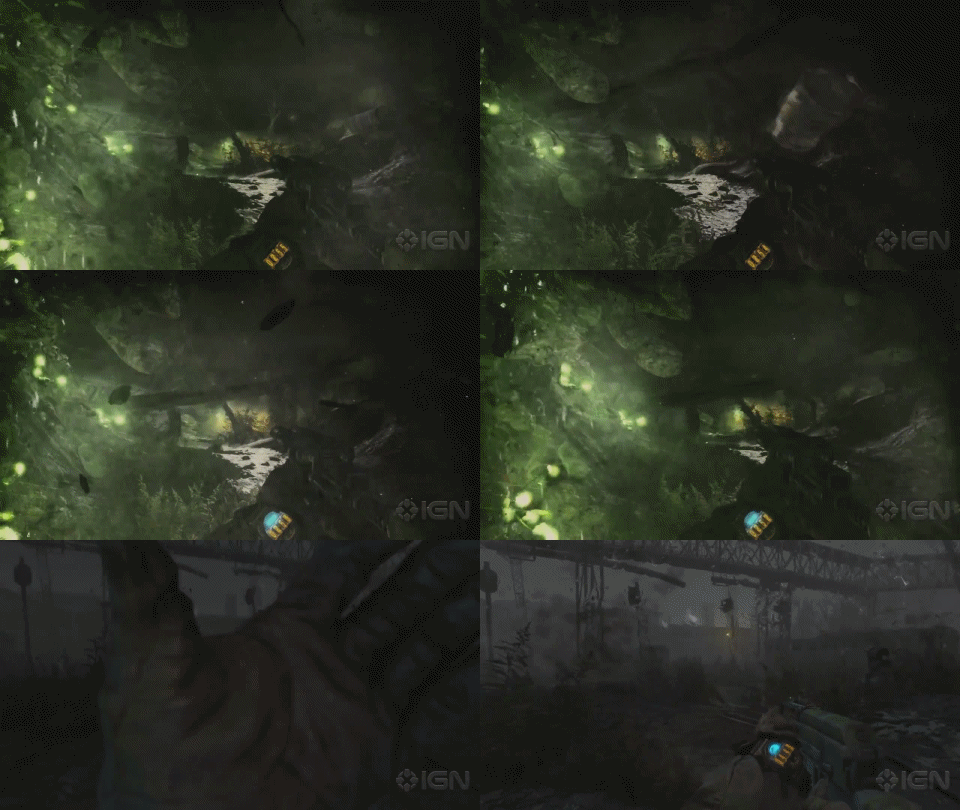
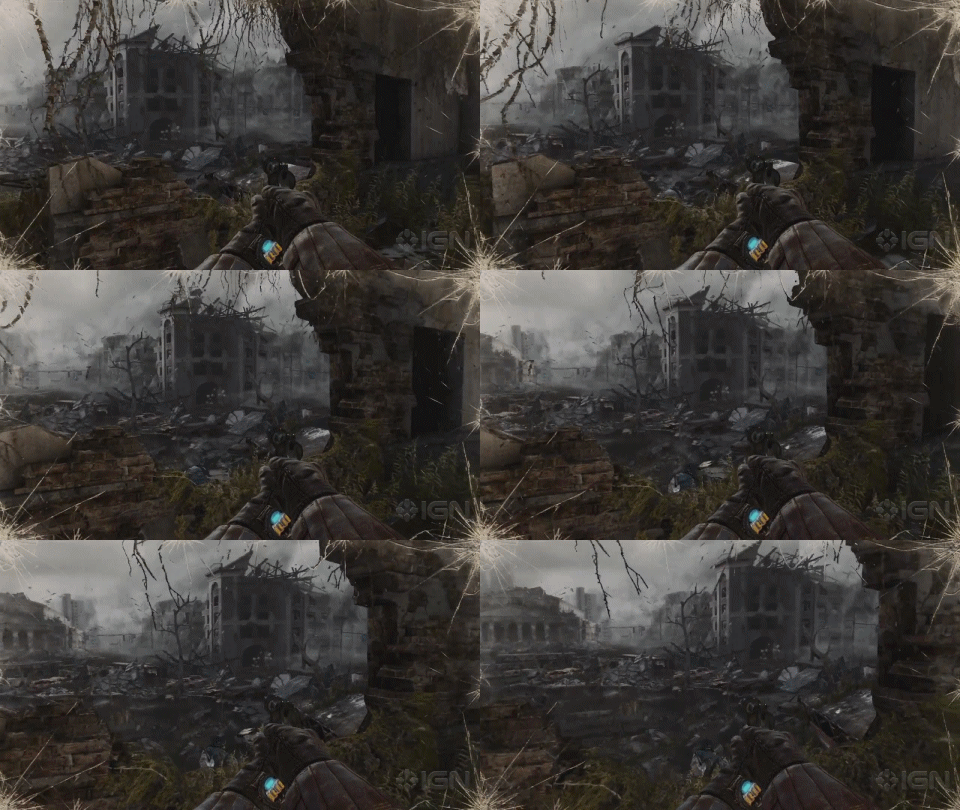
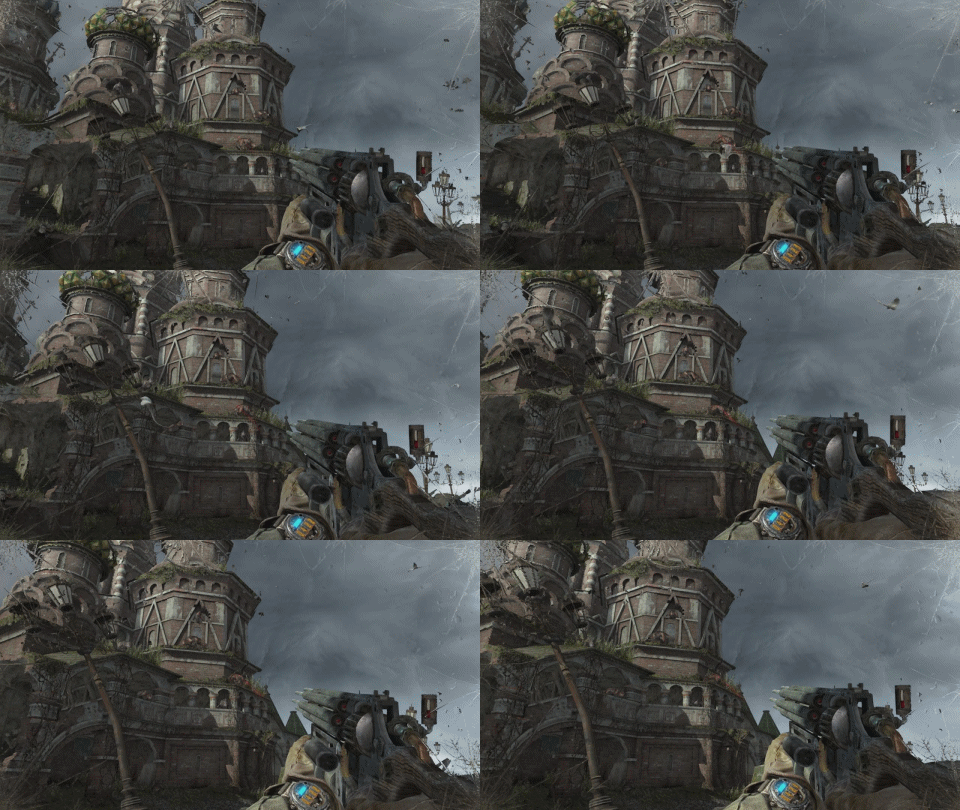
Mechanical noise in Metro: Last Light

Porcelain Masculinity

The Last of Us’ post-apocalypse is more psychological and personal than nuclear and cosmic. Here were see America twenty years4 after a zombie outbreak tore apart its infrastructure and left the bulk of the land lost to the state of nature. Surviving civilization built around the wreckage of such a massive loss again takes inspiration from its past trauma. In this case, the fear of zombies is a fear of losing one’s mind, represented as it often is first by the disintegration of concepts and customs of normalcy, specifically the collapse of society as we know it and the structures which define our present lives.

This theme takes the background throughout The Last of Us—it’s not quite about exploring topics raised in Night of the Living Dead or The Walking Dead. Instead, it’s taken for granted that what little humanity survives hides in walled-off settlements or nomadic groups, with the wilderness in-between the domain of bandits, survivalists and entropy. Although we briefly see glimpses of Boston’s quarantine zone as dystopian, and we know the Fireflies fight a cause against the present authorities, they’re never expanded upon. Not once throughout the duration of the story are we made privy to the motivations and details behind these societal struggles, since it only really serves as ambiance for the journey of our main characters. Joel accepts that society has fallen and the world’s turned to hell, and there ends his interest in the subject. He has adapted to it.

However, rather than the zombies of TLOU being of the old fashioned walking dead variety, it takes a more original spin on the old formula. Cordycep-infected react to prey much like the livelier crazies, but heed the underlying causes and logic from its real life reference: a parasitic fungus which consumes the brains of insects and overtakes their bodies to further its propagation. A cruel horror made more sinister by the reality of its existence.

By this, the fear of these zombies carries a teleological edge, since Cordyceps essentially function as mind control that irreparably degrades the host victim. The fear is less like dying and being replaced by a living dead, where there’s at least a clear delineation between where you end and it begins, and more like being eaten alive from the inside out while being made to do the bidding of some unfathomable lifeform.

The fear of losing one’s mind is more literal here. It’s a degradation and perversion of self, a corruption of one’s brain which would set the host upon their nearest and dearest. Partly, it’s a fear based in the betrayal of intimacy, which haunts Joel more than anything throughout his character arc, albeit subtly, since he roots his concept of self so heavily in that more personal societal structure: the family unit. And he disdains the world for taking it away from him.

This is a tricky one to pin down because Joel at once derives so much of himself from these interpersonal relationships at the same time as he holds them at arm’s length for the fear that they and he might destroy each other. To highlight how this fear is thematic within the game, we’d need to both show how integral family is to Joel’s sense of self and his resistance to succumbing to that self-perceived weakness.

So clearly his mourning for Sarah and his longing for the restoration of father-daughter bonds inform his relationship with Ellie the whole game through, since it’s the central relationship of the story and the one which most defines Joel at any given point. Otherwise, with Tess he lives within a certain comfort zone, a stable working relationship—their partnership being clearly defined to the ease of Joel’s self-establishment. With brother Tommy things are a bit rockier after their falling out: their relationship is strained but still Joel feels he can depend on his brother when his need is greatest.

To greater or lesser degrees, Joel’s emotional and psychological stability is linked to how well he feels himself fitting into each of the three roles of father, partner and (elder) brother. When his self-image is farthest from any of these roles he is at his weakest and most volatile; for example, after Tess dies and before he begins to form a fatherly bond with Ellie, and when Ellie rejects this bond coinciding with Tommy’s shirking of Joel’s brotherly authority.

The game extends the theme of family outwards to its minor characters, Henry and Sam, and Bill and Frank, so we’re given several stories of how the family structure is a guard against the horrors of this world and how loss of those relationships affects a person’s mind. Never so deeply as in Joel, however, whose psychological need to be a father ultimately compels him to doom humanity. This is the culmination of Joel’s arc, his “happy ending”—the overcoming of his fear of loss of self, and the cementing of his self-perception as a patriarchal figure to Ellie.

Which brings us to the last facet of the world’s trauma which I’ll be talking about: the fear of loneliness. Inverse to the comforts of family and friendships, when the gripping terror of turning against one another grows too much to bear, then we see the rising fear that one must face the world alone. It sparks many of Joel’s character traits—his over-protectiveness, his jealousy, his antipathy towards risky altruism and his hatred for self-sacrifice. As he grows more and more volatile after Tess’ death we can see how this fear consumes his soul. The very way he reacts to his daughter’s sudden demise as an abandonment, and the way he crawls up from his sickbed to rush to Ellie’s side, further suggest that Joel is petrified of being left alone.

This is The Last of Us’ spiritual component, or rather, how its world seeds a spiritual fear. We see through Bill how loneliness gnaws at one’s soul; we see it in Henry’s suicide; we see the spiritual sacrifices David’s crew chose to make to maintain their community. And all throughout, we see Joel’s petulance in how he clings to his current comforts and aptitudes, and the toll his chosen life is taking on his humanity, to which he is oblivious. It is a condition he supposedly triumphs over as the game arcs to a close, although bearing in mind how he prescribes his own spiritual completion perhaps that victory remains dubious.

Misused scalpel

So throughout each of these facets of the gameworld’s central theme, where fits the ludonarrative of the player’s interaction with the world? We have an abrupt and clean ludonarrative, almost peaceful and accommodating to the player in how it relates the world around them, and we have the various ways in which the world tears at the psyche of its inhabitants, threatening them with loneliness, insanity, and brutality. How does the manner we as players view the world play into or against the narratives of these characters or the story on a whole?

Perhaps the answer will come to me in time but as I write this I can’t for the life of me see how the one part could apply to the rest. The themes we’ve gone through are so heavily predicated on horror and one’s inner destruction that the pleasantry with which we come to the gameworld and engage with it is alarming, almost sociopathic. It’s as if Joel’s personal conception of the world is so stoic and emotionally divested, the fervour we then see in cutscenes where he shouts and laughs and cries is entirely faked for the benefit of the people around him. Or in other words, we have to doubt the passion of this game towards the emotional journeys of Joel and Ellie in order to adequately contextualize this ludonarrative within the whole.

Half of me is inclined to take that interpretation at face value and accept it as canonical. It’s an arseways jigsaw puzzle where the pieces don’t often fit each other very well, and you know, that’s generally the way of it. The other half of me balks at how artificial that reading would actually be, how much of the narrative we have to contrive to have it end up making sense, and the fact that this interpretation has us disregarding huge portions of the text as hollow, contrary to the clear effort gone in to making it.

Of course, this incoherent totality is a product of a design ethos that deliberately splits narrative from gameplay and formally compartmentalizes them. You have your cutscenes (where the story and narrative goes) and you have your gameplay (where the act of play goes), and never the two shall meet. It’s a delineation that comes, not from the loading screen that separates the two bits, but from the mentality with which its authors approached the game’s composition. That would be my exegetical explanation.


1. To clarify, there is a flashlight in TLOU that you can turn on and off as per your needs, and it sometimes flickers and dims as if the battery is coming loose in the casing. There’s a great solution here where the player waggles the controller to put the light back in order, so it’s not like TLOU is absent of gimmickry. Except, by the way the game is structured, you’ll never have your light on if you want to keep a low profile, and places where you don’t care about your profile are also places where you can take all the time in the world for waggling the controller. In effect, the gimmick is playful, not stressful.

2. All the nameless bits and bobs you collect are grit for the game’s crafting mechanic, or for upgrading Joel’s weapons or his personal survival prowess. We can haggle over whether these aspects succeed at simulating Joel’s resourcefulness or charting an arc of personal growth in his abilities—I’d argue crafting loses its touch once your inventory overflows with weaponized toys and supplies, which is bound to happen if you collect every glowing trinket that presents itself, and that most of Joel’s survivalist upgrades are so underpowered as to lack utility.

3. For the sake of setting these two games as analogous to one another, a few points of clarification: Metro: Last Light uses a first-person perspective, and given how the story plays out (Artyom is a silent protagonist, except for diary entries and loading screen synopses; his/the player’s actions influence the plot’s trajectory) it’s safe to say the player is expected to identify with Artyom through an appropriate lense. The Last of Us uses third-person camerawork—we can see Joel and his expressions, read the silence on his face when he can’t speak words he wants to, understand and extrapolate narrative from his body language in relation to Ellie. While the game uses various techniques to bring us close to Joel, I don’t think we’re quite meant to identify with him as if he were an avatar. Instead, Joel is held as an independent character to player self-identification. We like him or hate him, but we are not him. This is all a preamble to point out the fact that Joel’s and Artyom’s methods of interacting with the world differ by fact of their representation on-screen as well as in their relationship with the player. It’s not a 1:1 comparison. Anyway, some of this business about camera perspective impacting player identification might be contentious so I’m relegating it to a footnote.

4. I don’t know why twenty is the magic number for post-apocalyptic worlds.

A Manifesto on the Correcte Identification and Maintenance of Members to Our Deare Club

Manifesto for Our Club

Thee words hence are community funded. In the accident that one should wish to see them continued, one may support my work by attending my Patreon and becoming a patron.
Words and artwork by Stephen Beirne.

Long is thee day upon us in which we, my proud brethren and I, must dedicate oureselves in embarking upon the very right of our self-preservation. Equally long have we reclin’d indulgently, leading us directly to this trial, where we have allowed, through benign acquiescence, thee subtle march of undue women through our places of traditional refuge. As one does a curious sparrow through one’s garden windowe, we have watch’d with passivity as these troops inseminated our homes, our livelihood, with themselves, and oh now we taste, that veiled poison that is their traitorous minds.

For troops are these truly—an invading force of female spies, whom have arrived collectively in drips and drabs for the sole tactical purpose of subverting, and corrupting, the values upon which we predicate oureselves, my fellow brothers. Warring on not just thee fact of our identity, but our culture, our simplest values, basic and fundamental, for thee sole purpose of rattling from inside out our state of peace and brotherhood away from them, but waging unprovok’d battle out of spite and greed that we should be pleased without them.

Nevermore.

Though we count what ground they have won in yards, it is not yet lost forever to thee clutches of these wretch’d pursuers, say I; as with certain motives taken deep into our hearts may we regather our position to dispel those feminine colonists back to their hatefilled land of Gloome.

Together in the effort of my collective gentlemen, who shall remain unnamed, for the safety of themselves against the threat of their local females, this manifesto is publish’d in structuring thee affairs of our future comportment and self-identification, in protection against thee future risk of contamination, and outlining principle stratagem by which we may obstacle thee continued annexing of our peaceable homes.

Principles by which our Club may be Sanctify’d against the Female Horde

Principle 1 -

Prior to discerning thee propere character of our enemy, ‘tis of high priority we should establish means by which inclusion within our home may be ratified, by process of deduction from its innermost nature. Fortuitous so, that the time-honour’d integrity of our club brings forth time-honour’d marks by which members are accredited, through activities shared in our habit as establish’d by tradition. Pay heed to yesterday and yesterday’s doing, for these did us well in our youth.

Such it is, as we knew each other yesterday, so we will know each other tomorrow, through enjoyment of the activity of bygone times; for newcomers shall find these to be strange and foreign, having not the chance to grow accustom’d to their normalcy. Pay not attention to today’s occupancies which do not abide the custom of the respect’d past, their Goeth Homes and their Candy Crush Theses, for they certainly represent an alien spirit with absent care for their clear blaspheming.

Through lavishing objects of our preferences with thee quality of utmost integrity and validity, one casts in mental iron appropriate categories expect’d of the form of our sacred recreationals. A secondary effect of this, pertinent for tactics to follow, is to preclude as untrue any example befitting the soppy humours of the human female, which, one can later attest, is a division innate to the nature of the whole category, and therefore propere. By this we expel the females through ablution of thee medium, cleansing it from their touches of production and favoure.

Principle 2 -

Reput’d as is our club for its loose attribution of members, attract’d here only by the common love and appreciation of their oddity, so reject’d from society on no basis other than being who they are. Hold in oneself that this shall stay the heart of our community, by which we outcasts shall accept one another and others aside as our fellows and brothers, for struggle so as we do together in this cruel world. Open one’s heart to all finding their way here, be they familiar or unknown, friend or foe, on the sole ground of this mutual love of our activities, and say to them, let all men be welcome.

But beware thee female, that sly creature, whose present’d adoration is most commonly found as a falsification. Know the liar by thee ignorance she conceals, on the status and minutia of our preferred medium, proving her love as superficial and dubious.

Though tales are heard of some sincere female specimen, the wise brother should take great caution to interrogate each strange female to root out false applicants, as deduced by criteria establish’d in Principle One, or by the female’s declaration of taste for activities unusual within one’s doors. By this rule, should the female human respond to inquiries with an interest in foreign components, such as Le Sims, or the incorrecte part of any traditionally acceptable activity, one must cast her back in rejection, and mock her incessantly. One is oblig’d so in maintenance of the purity of our very identity.

Principle 3 -

Alas one may encounter a staunch brother, proven in sincere love for oureselves by his visible nature, yet having abandon’d the creed which is here set out, and taken up arms as comrade to the females against his very home. This sorry state becomes of those who seek too far the affexion of the feminine enemy, for the hunger in his loins overcame his senses, and so he turn’d native and now festers in their debauchery. No other cause is conceivable.

Refrain from combating our Fallen Brother, but instead regard him in pity, for his betrayal is despite himself a symptom of more female corruption. Lavish him with the title “White Knight”—a figure of great fame and moral integrity in eras past—for thee irony of such an accusation shall be instantly recognizable as scathing and wittiful. My brothers, your shocking words will seed within the Fallen Brother’s bosom for years to come, until one day it flowers, to toss him from his foul horny disposition and restore him to our place. Such is the great effect of the association of “White Knight” it is expect’d many a Fallen Brother shall return to us any day now.

Principles by which Females may be Expell’d from our Club

Principle 4 -

Having staked the ground and marking it as rightfully oures, with our urinations, we may now progress to the execution of thee active expression of our dispositions through open communication with the enemy, in reclaiming terrain lost to those swarming crawling womanly oppressors.

I say, have faith that the kindly prestige of our club shall protect oneself in this affair, for it is here both a shield and a sword. Many brethren have discovered, in exuding with confidence a pleasant demeanour, and lacking all presence of hostility and disgust for their reptilian lot, one may engage with a female in totale invincibility and sinlessness, as evidenc’d by one’s airs. Pretensed so, one is made unassailable by dashing the female’s lone chance for attack: her accusations of mysogyny, which, with no immediately obvious substantiation, dissipate harmlessly into the atmosphere as breath in the wind.

Coat’d in this benign armour, one may barrage any number of females, to politely demand a portion of their time and effort be dedicated, with respect, in attending a menu of arguments against their existence, which, it is known, no female can or has ever anticipated. For each civil inquisitor who joins in this venture, the female correspondent is obliged to commit words, such that a single female may be diligently peck’d with pleasantries by a flock of gentlemen, until she inevitably withdraws from exhaustion, with no risk to the gentlemen themselves.

A danger here resides: the actions noted above are perilous, for by their very nature a fellow may come to encounter the females, and may thereby be contaminated, as in Principle Three. Be forewarn’d not to dally, nor to perceive in writing or sound thee responses a female offers to one’s batterings, lest the snake’s words rid you of your senses.

Principle 5 -

Should the female refuse to engage one’s nattering in civil communication, by responding with edged tongue, or responding not at all, a facility is in place for this occasion. It is, in truth, a fortunate alternative, when thee manoeuvre outlined above proves too strenuous for a gentleman to maintain, as communication with females is understood as a notoriously trying affair for the duration that one masks one’s contempt.

For the civil inquisitor who tires of the act too early, and for the impatient gent whose sensitivity disallows him to even feign tolerance, drastic matters are to be undertaken. ‘Tis acceptable, in the case of an unruly or vocal female, to discard the shackle of civility and let loose on the fiend all manner of valid and correcte insults and recommendations.

Reference the correspondent with names of unsavoury and exotic beasts. Denounce her lineage as remov’d from thee noble houses, a likelihood in most cases, while reminding her of the improbability by which a suitor might validate her adult life. Relate a maxim once said by a popular comedy man. Thee cheekiest of fellows might insinuate themselves as favourable to thee female, and so are socially permit’d, when that generosity is invariably rebuked, to decorate yon wench with a counter-intuitive reputation.

‘Tis a most joyous pastime, best undertaken with a dry Riesling of one’s choosing, so do ensure one explores one’s best imaginations with regards one’s interjections.

Seized by a righteous frenzy, a fellow may then feel it propere to grow full hooligan, and turn his destruction onto thee privacy and livelihood of any female in proximity, being carnage unbound, for a female’s protective scales are as diamond against the emotional toil affect’d by this upon any normal human. I say then: pursue that whim. For the purpose now is to raze thee land, our rightful home, into as hostile and wretch’d an environment that only we approv’d gentlemen should wish to stay. No threat nor damage to property nor sanity is too far, for we are validat’d in our actions by thee moral high ground, predicating our standing, and presumably still held, or we have yet to recognize otherwise.

Recall, as motivation and comfort, that the female originally escalated the conflict in impressing herself upon our scenery, whereas before she was discrete. By this meter, that one merely reacts to a cause, compiled with the evidence of the target’s grotesque gender, one is absolv’d of any crime of character typically attribut’d of such heinous actions. Openly regard your deeds as harmless, naught more than mere words and prankstering, and know that this is wholly true, for our benevolence prevents us doing otherwise.

Nevertheless it is suggested, in guarding access to Principle Four should future need arise, for a fellow to place one horsehair moustache upon his upper lip, purchased in a shoppe for twopence, to conceal his identity. By this inscrutable disguise, social distance may be contriv’d between gentleman and hooligan, though they sometimes be one in thee same, so hence one may denounce thee latter character as suits to preserve thee honour of our fine club, with females none the wiser. Alike goldfish, the fey buffoons. This, again, deprives thee female horde an opportunity to admonish oureselves as misogynistic, which we maintain we are not, regardless of actions recently undertaken.

Principle 6 -

Finally, as loose a band of individuals we are, it is reasonable that we form organized contingents, and structure our innermost society contrary to its open nature. Never mind that, but obey in thee application of our combin’d force against thee unify’d female throng, for doubtless they are so connect’d in secret collusion, all together, thereby explaining their dominance over men.

Do not hesitate in this, for the females assuredly manifest our impending demise, already intimated as they are to our social betters, such that, with one word, a single female will set the ban to dozens of treasur’d activities. Oh the monstrous, writhing coven, they have us dead to rights! Pray fear them! They do outnumbere us!

With this now known and here proven, it is imperative for we to seek out new monarchs, to figurehead oureselves in opposition to the females’ similar rallying. Demonstrably bless’d by God are we, for such leaders come quick to mind in their multiplicity, and pre-exist theirs by years, and proclaim greater numbers of followers, such that our joint political power dwarfs thee efforts of even thee shrillest enemy gorgon.

Command’d so, only then may we celebrate our prized autonomy, the foundation of identity and self-adulation upon which our deare club is form’d. Brothers, clad yourself as soldiers, every one of you, in the uniform of an iconic character from yon popular pantomime, the Masked Gentleman Clown, for in modelling oureselves on a mime known for his political posturing, we shall most assuredly be accept’d in the vein of seriousness to which we aspire. Adopting this guise, we shall absolutely celebrate each of our identities, and bask in mimick’d respect of oureselves by virtue of thee visage of another.

I say to you now, already we find, scatter’d amongst thee vastness of our club, a legion of infantry beyond what we had dreamt. And outwards, to the society that shun’d us in our youth, supporters do rally to our cause in the clothes of dukes and monarchs, so likeminded are we, brethren in all, together against thee females. In those who outcast us we will find allies, for our differences are like thread to the bonds we share in hatred and fear of the new tourist. Reside not much longer on this point, but accept by my words that the female devil threatens all of civilization, but is, at the same time, no threat to our mighty civilization.

For ‘twas indeed our land before they scuttl’d in, and such with the certainty that our strength comes tenfold, one hundredfold, one thousandfold times theirs, know in your heart that we underdogs, we oppressed, shall prevail against thee feminine tyranny.

Kotaku’s Policy on Patreon Support

Kotaku's Policy on Patreon Support

Originally published on Unite Youth Dublin on 28/8/14. My writing is community funded. If you like this article, please consider supporting my work by visiting my Patreon and becoming a patron.

This week saw major videogames publication Kotaku updating its ethics policy in an unpopular direction. Given that games journalism is generally notorious for corruption and nepotism, Kotaku opted to mend the field’s reputation by barring its writers from supporting the potential subjects of their reporting via Patreon, a platform for creators to fund their work through patronage. By banning its writers from backing any game developer on Patreon, Kotaku hopes to present the staff as personally, emotionally and financially detached from the developer’s professional success. By this policy they believe an ethical standard is met.

However, Kotaku still allows its writers to directly purchase a game for reviewing, or to back projects on Kickstarter and Indiegogo, two other, more established platforms for people to crowdsource revenue, despite the fact that both of these transactions also involve the writer financially supporting the developer. Where Kickstarter and over-the-counter purchasing differ from Patreon, according to various writers and figureheads at Kotaku, is that through them you support the product, whereas through Patreon you support the person.

That is the logic they have outlined. To briefly recap: supporting via Kickstarter is ethical; supporting via Patreon is unethical.


Corruption in Game Journalism

While there are many problems in this new policy, two particular concerns stand out in my mind. The first is that the reasoning behind it presents ethics as rooted in the extent to which a trade relationship resembles traditional capitalism. The further removed a creator is from the thing you’re buying, the more dehumanized your purchase so the more ethical it is. Although on Kickstarter you’re still funding a developer’s livelihood and receiving a game in return, the sense of removal is familiar and comforting, and has grown normal as Kickstarter has melded into common usage in the industry.

Since patreon phrases payment as if to a creator’s work in general, rather than in exchange for a specific product, investment doesn’t result in property for a patron to claim and consume, conflicting with the values of a consumer-orientated culture.

My second concern is with who this policy targets. Patreon users tend to be those creators who have found little support through mainstream industry channels, notably in this case for structural reasons, and so migrate to the more-accommodating patronage model. By this, under-appreciated and marginalized game developers and writers find an outlet for their work. In essence Patreon is a way for marginalized voices like women, queer and trans identifying people to find their work rewarded by a hungry audience. Out of the mutual support and interest this platform facilitates, a self-sustaining community has formed among marginalized developers and writers.

Establishing a videogame monopoly


While Kotaku is quiet as to whether its writers may pledge to the Patreons of other writers, by disallowing pledges to devs, it threatens to nip this community in the bud. Now, if a freelance writer with a Patreon wants to have their work published for Kotaku, they must distance themselves from the support they give to other creators and presumably discontinue the pledges they receive from their peers.

As well as driving a wedge into the community of marginalized creators, this could also be a tactical move on Kotaku’s part. By monopolizing the sources of revenue of its writers, Kotaku is guarding a treasured resource—its pool of freelance writers—by restricting them from turning to Patreon as a viable alternative to mainstream publications. In doing so they simultaneously drain away Patreon’s clientele, thinning the damage it could do to the gaming press status quo. As many outlets seek to court marginalized voices and tap into their previously dormant audience, by making its writers financially dependent on the outlet Kotaku is acting to control and exploit the workforce.

It should be noted that Polygon has published an alternative policy for journalistic ethics surrounding Patreon support. From now on, Polygon’s writers must disclose whoever they pledge to when it might be relevant to the story. That’s all it takes.