Project Zero 2’s projector room

This piece is community funded. If you like this article, please consider supporting my writing by visiting my Patreon and becoming a patron.

[Minor spoilers for Project Zero 2]

The best horror preys on grounded fears. Even in media portraying the object of horror through supernatural or preternatural elements, the extent to which a piece of horror engenders a lasting impression depends on how relatable the underlying terror is to its audience. Night of the Living Dead depicts fear of social and mental instability; Jacob’s Ladder focuses on the latter. Rosemary’s Baby is rooted in the insidiousness of spousal abuse, as is The Amityville Horror. Alien draws on fears of feminization and the female Other. Ringu is grounded in the anxiety of loss of control. A Tale of Two Sisters taps into terrors of familial corruption; The Exorcist plays that against our spiritual insignificance. My personal favourite, The Thing, speaks of unknowability of our fellow man.

Many videogames ground their horror in the inversion of safe spaces, which is a sensible enough tact given how players are typically expected to take in three-dimensional spaces in order to move around them. The settings for horror games are often schools, hospitals, police stations, houses, towns, stairwells, twisted and distorted in their natural rhythms and then populated with whatever ghoulies characterize the story’s pretence.

Project Zero 2 (aka Fatal Frame 2) is one such example, taking place in a deserted, haunted village in the Japanese countryside as protagonist Mio searches for her lost sister. Much like Ringu it bends supernatural elements around mysticism of the familiar in the forms of technology and locale—you fight ghosts with your spiritually-enhanced camera obscura.

The exciting thing though is how it represents these safe spaces to the player in a subversive way. To show you how Project Zero 2 composes its scenes to evoke anxiety from this base theme, let’s take a look at the scariest room out of the entire village: the projector room in the Tachibana House.

Project Zero 2 camera and composition 1

The projector room, map view.

In the spirit of the game’s enthusiasm for old technology I’ve taken these screenshots with a handheld camera so you can get the full view of my television. Also because I don’t have any other means to take them.

The projector room is a rather small space housing little more than a wall-sized screen and a film projector. Because it’s such a tiny, claustrophobic room Project Zero 2 really gets to make the most with its second-person perspective, which is the sort where the camera is affixed to a scene at a particular angle and position decided by the game’s creators, rather than controllable by the player as in first- and third-person perspectives. This has a really neat effect with player identity, but that might be best left to another day.

In games that use the second-person perspective, some cameras in a scene tend to be stationary while others pan to follow your character as they walk about the area. When the player walks to the edge of one shot, the camera angle will change to give a different view of the room to accommodate your new location.

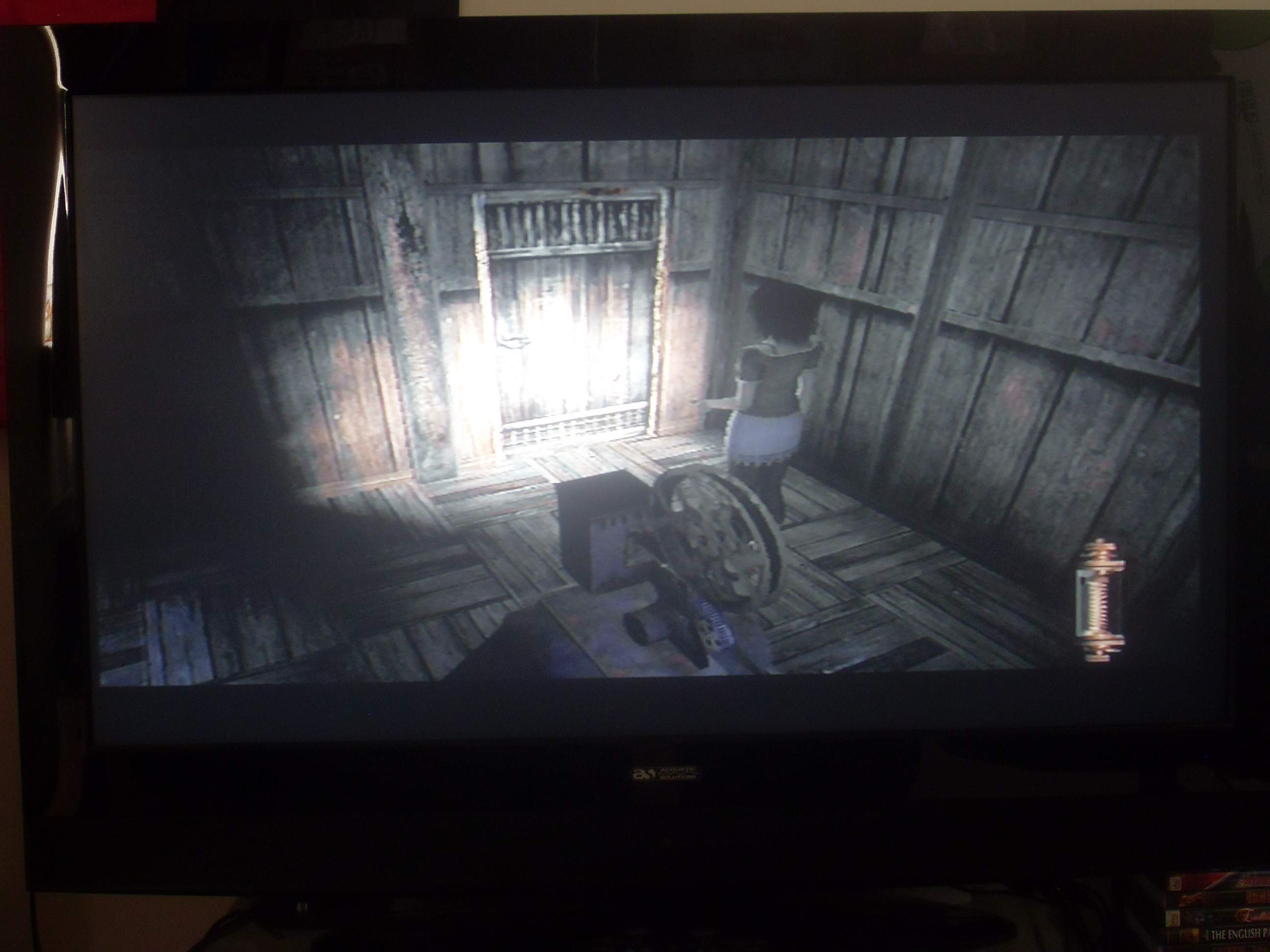
In the case of the projector room we’re given four stationary camera angles with which to view the space. Entering through the door on the south-east corner will give you this camera angle:
Project Zero 2 camera and composition

Camera angle 1.

In the foreground you can see the projector, set on a table right in the centre of the room. You can walk right up to the projector and start playing any film reel you’ve picked up so far in the game, but because the projector screen is out of shot you won’t be able to actually view the film from this position.

Anyway, when Mio is standing at the door there are three directions she can walk in: backwards, leaving the room; to the left hand side of the screen; and to the right hand side. So long as you keep Mio within the frame, the camera will stay fixed, pointing straight at this door. If you move her too far to the left of the shot, the angle will change to this:

Project Zero 2 camera and composition

Camera angle 2.

There we have the projector again but we still can’t see what it’s pointing towards. Instead we’re given two other points of interest within the room. The first is the door on the left hand side, slightly obscured by the projector, which when you’re playing the game is the direction you’ll want to head next. The second is that great big blue curtain, covering a wardrobe which takes up most of the northern wall. We’ll get back to that later.

Continuing on leftwards switches the camera to this next angle.
Project Zero 2 camera and composition

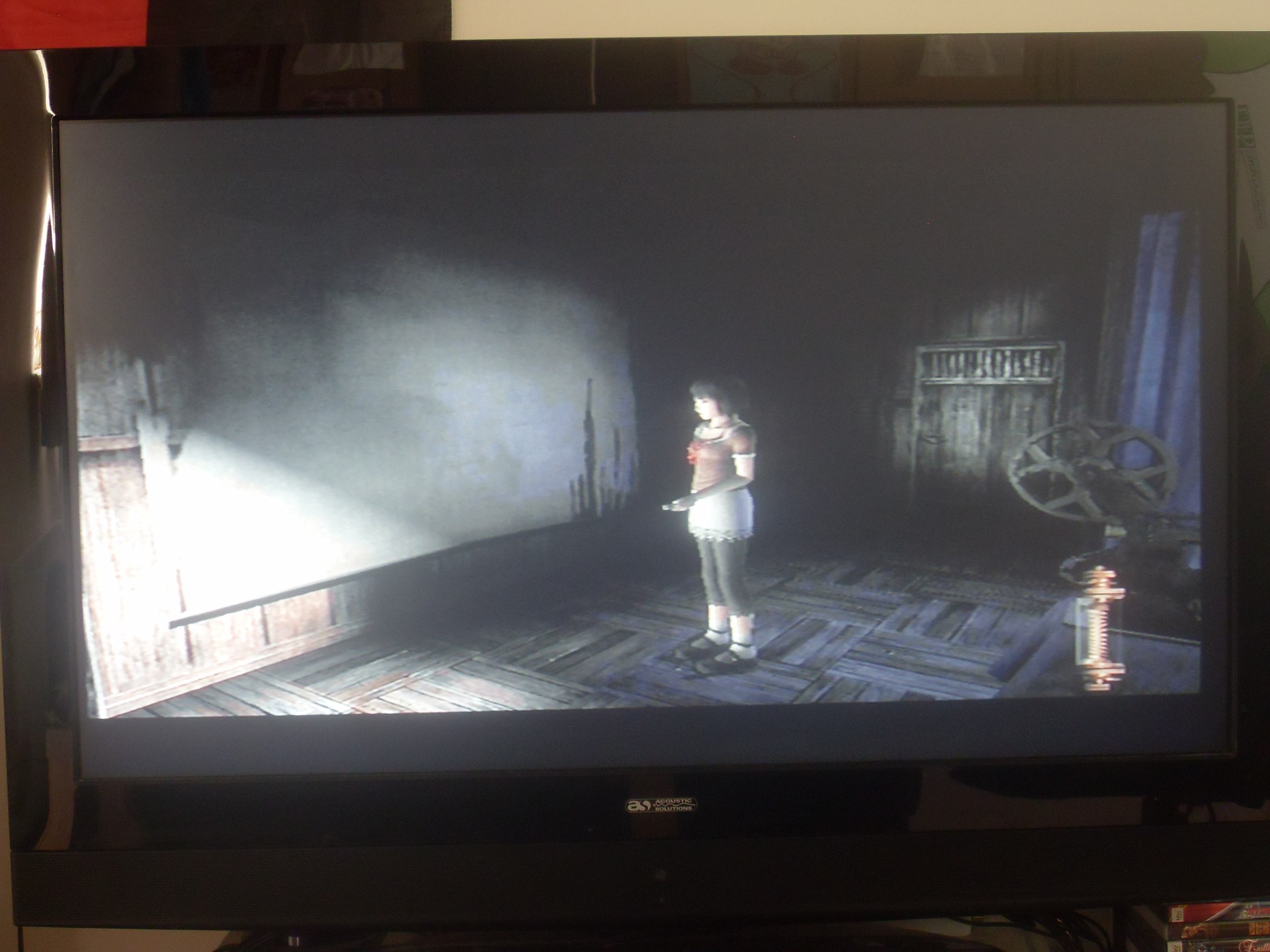
Camera angle 3.

Now we can see the projector screen, so we’d be able to watch whatever film reel we decide to play. This is a great shot for showing us what’s on the film since the projector screen takes up about half of your television and Mio is clearly right there in the centre of your view, granting you easy visual access to her position and surroundings.

There is, however, a catch. I’ll tell you what shortly.

In the room’s corner just askew of the centre of this shot, a small divider rests propped up to the wall. It stays shrouded in shadow unless you point your torch at it, so here’s what that spooky corner looks like at the best of times.

Project Zero 2 camera and composition

Nothing spooky about it at all, although by pointing your torch there the entire left side of the screen plunges into darkness, so chances are you’ll prefer to face yourself as in the previous screenshot.

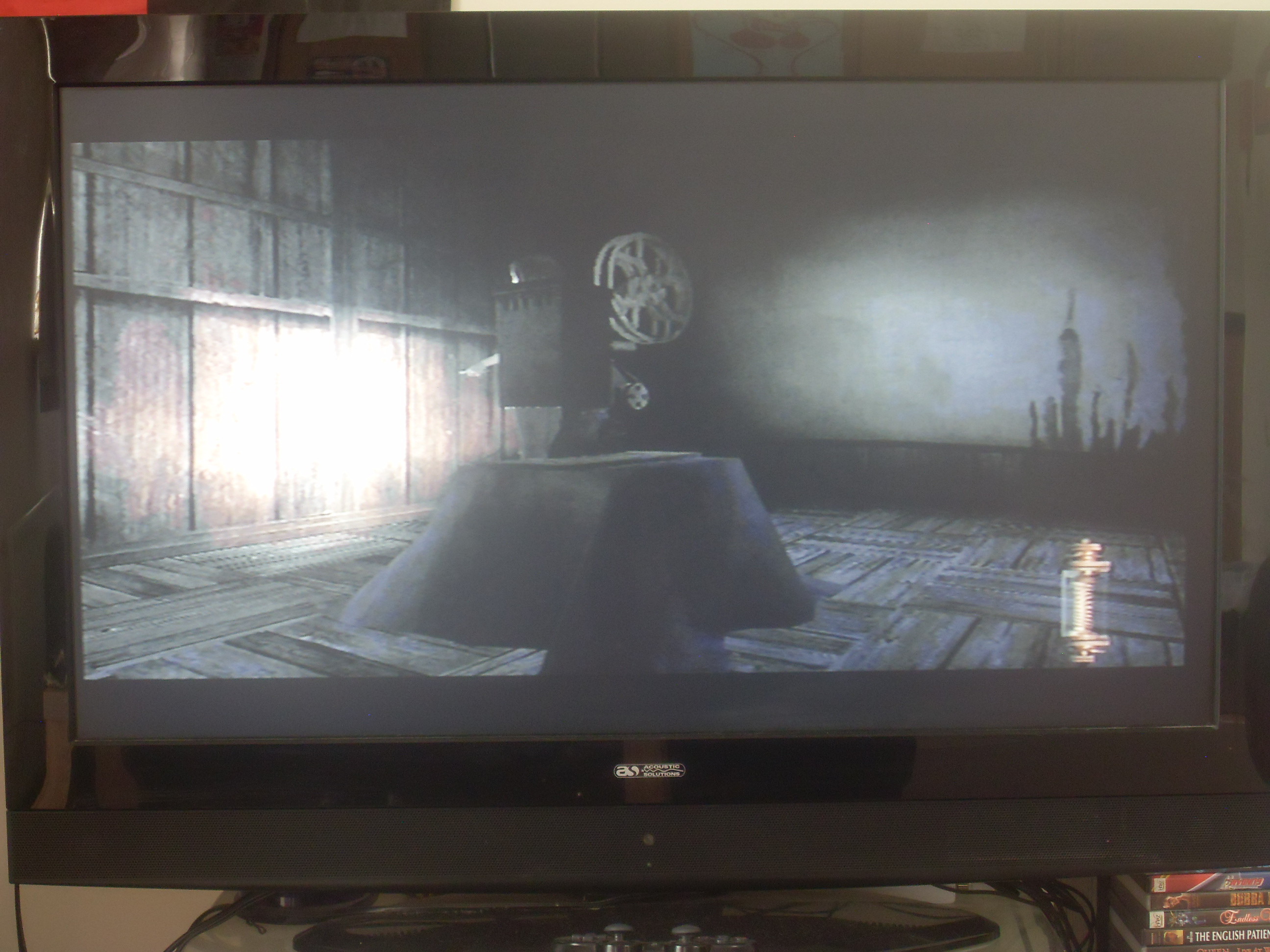
Moving on, when Mio walks to the left and slightly downwards the camera switches to this nasty shot:
Project Zero 2 camera and composition

Camera angle 4.

The problem with this angle is that Mio can’t walk straight through it without becoming obstructed by the projector dead centre in the screen. This is where Mio ends up after leaving the previous shot by the left hand side—as you can see she’s almost completely hidden by the projector.

This angle is rigged to deliberately jar our visual connection to Mio as she wanders the room, since by doing that it breaks contiguity of our psychological relationship with her. When the camera switches to this and Mio is hidden, we experience a moment of anxiety in trying to locate her/ourselves on the television. And since we can’t tell immediately whether she is safe, we therefore cannot tell whether we are safe.

This momentary fright is remedied by moving a few feet more to the left, where she’ll end up here:

Project Zero 2 camera and composition

But even this position is not terribly ideal since we’re given a very limited view of the space peripheral to her. If a ghost comes out of the wall to attack her, we won’t have much opportunity to avoid it.

Note that we can still see the projector screen in full on the western wall. This is as close to a full-on view of whatever’s on the film reel as the room’s camera angles will allow. As well as this, the comparative distance between our point of view (and Mio’s ideal location on-screen) and the projector screen itself gives an impression of relative safety should anything jump out from it at us. Hypothetically speaking.

In essence, this shot gives us the best angle from which to view the film reel but at the cost of a sense of security given Mio’s positioning.

Now, completing the loop, if you keep moving leftwards you’ll arrive back at the entrance on the south-eastern corner.

Project Zero 2 camera and composition 1

So these are the four camera angles of the projector room, labelled 1-4 going anti-clockwise from the entrance. You can see that each camera angle adds something and takes something away—for instance, shot 1 makes for a smooth entrance and exit through the south-eastern door since it’s bang smack in the middle of the screen. When you enter this room for the first time, you can instantly see where Mio is.

The first trade off of this shot is that it doesn’t give you much of a view of anything else, so Mio has to walk straight into unknown territory for us to see what else is around her. The second trade off is if Mio runs straight ahead after entering through this door (there’s a button whose function is literally “run straight ahead”), she’ll end up running through shot 4 where she becomes obscured by the projector, putting you in a bit of a fraught position if you’ve not yet gotten your bearings about the room.

This second trade off applies to shot 3 as well—if you run forward after entering through that door, you’ll move straight into shot 4. What this means is the quickest route to pass through this room from either direction, which also involves the least navigational effort by the player, puts you through a jarring moment of obscuring Mio adjacent to a sharp camera switch.

This is just a small aspect of clever level design that’s worth appreciating, especially for what comes next.

So right about now you’ve made the circuit of the projector room and gotten a rough feel of it. There’s still the problem of the billowing blue curtain—scenery motion in Project Zero generally signals a warning, so an enormous curtain that’s centre framed in a shot is pretty damn ominous. But you can’t interact with it just yet, you can’t move through it and you can’t see what’s behind it, so you’ve no option but to leave it be for now and hope nothing scary happens from it.

The first time you enter the room it’s likely you will already have viewed all the film reels in your inventory so far. You can rewatch them on the projector here or you can move on with the game, which takes you to the door on the northern wall.

Project Zero 2 camera and composition

When you walk up to the door and open it, the camera angle switches to one much closer to the point of action. This is normal for every door in the game, I think. When in this mid-range shot, Mio opens the door and it will stay open until the player walks through it or guides Mio back into the room and out of the current frame.

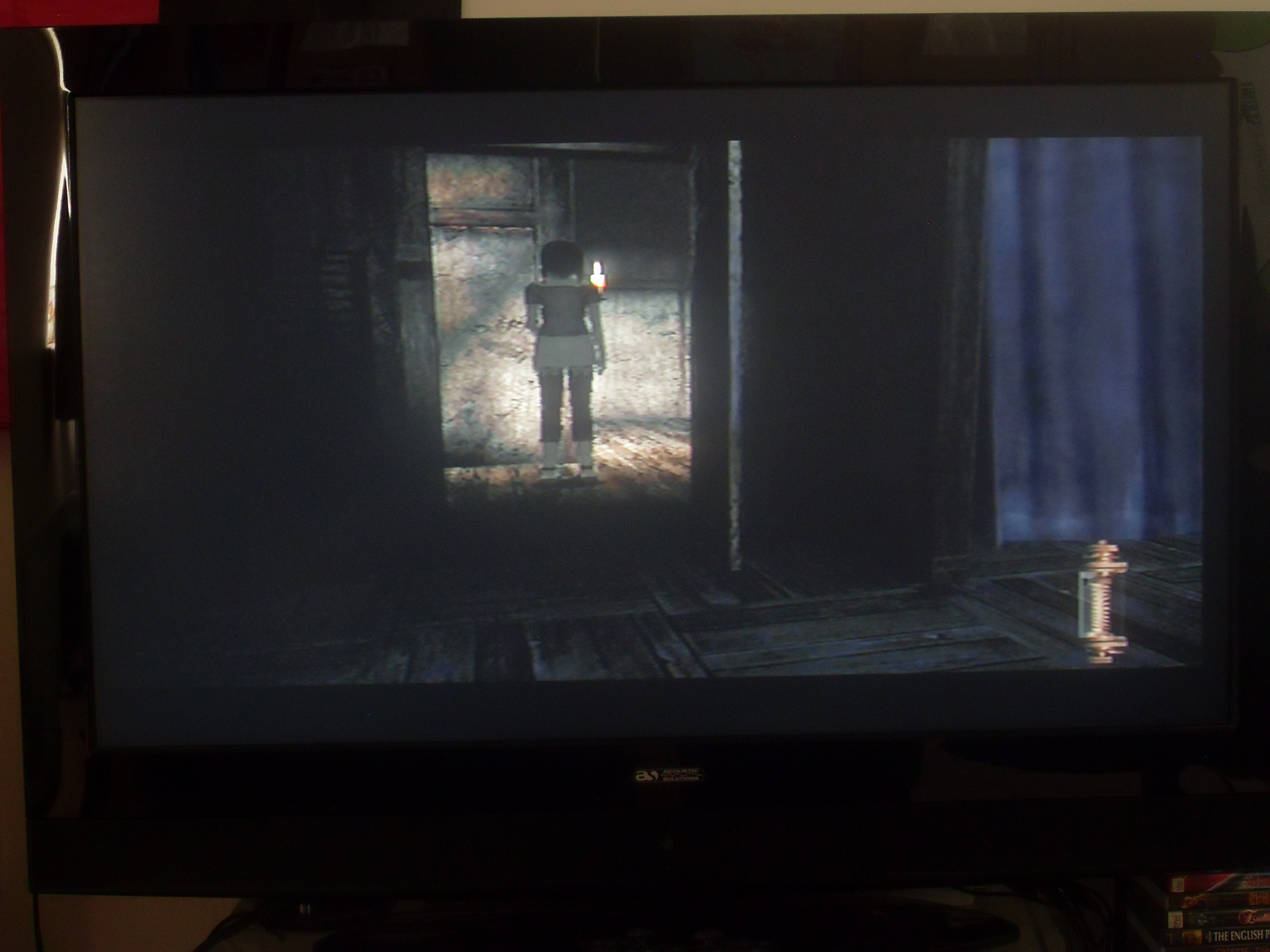
This is the shot if Mio walks through the door:
Project Zero 2 camera and composition

Projector Room doorway.

A beautiful thing Project Zero 2 does with its doorways is, the camera will linger until Mio walks out of frame, in this case to the left or right. As with before, you need to walk blindly into the unknown in order to see where you’re even going. In a haunted house where line of sight is literally your only defence against your attackers this makes for a frightening plunge with every new room you encounter.

If you remember the map layout from the very first picture, going left takes you right in front of a doorway.
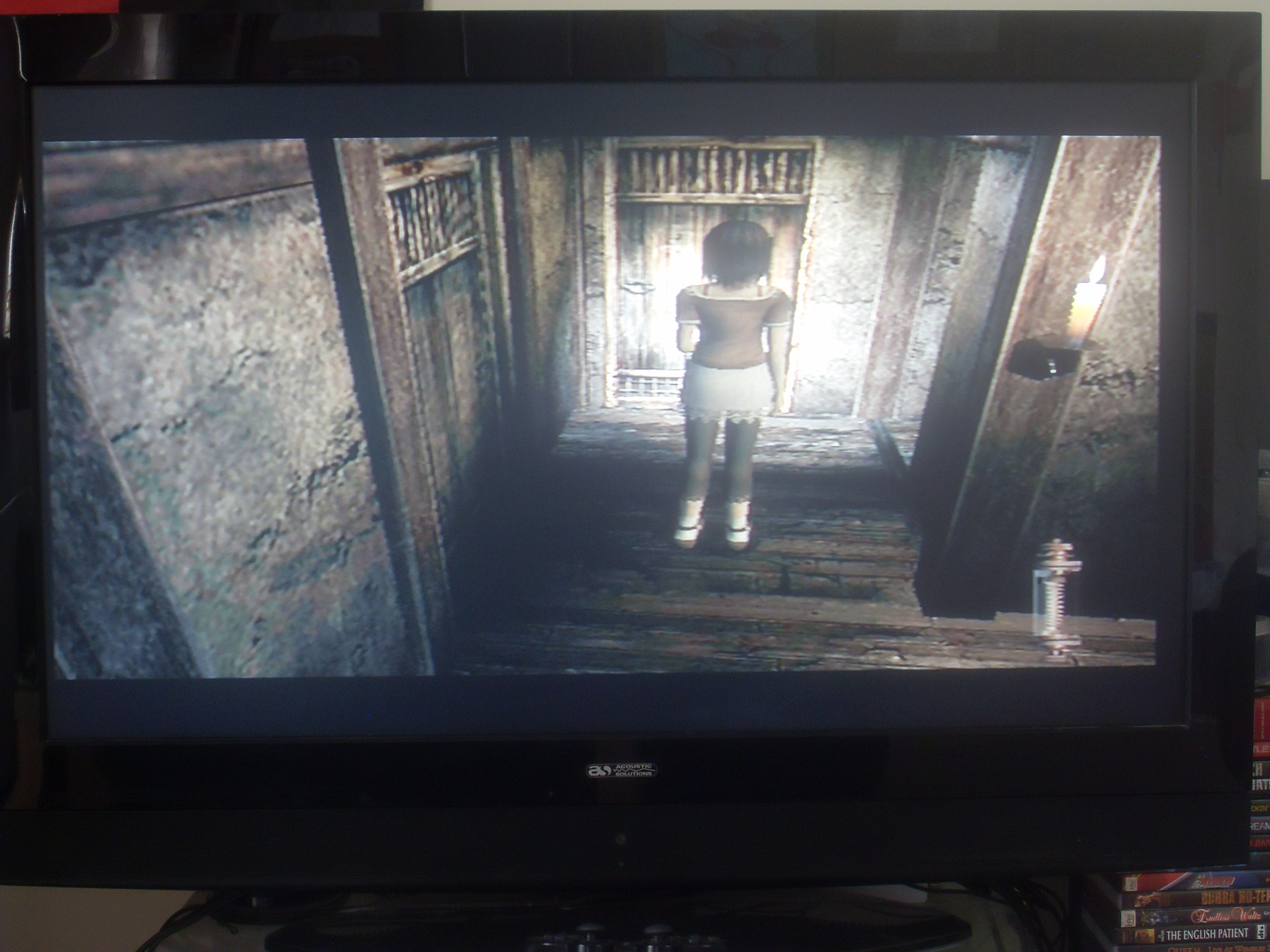
Project Zero 2 camera and composition

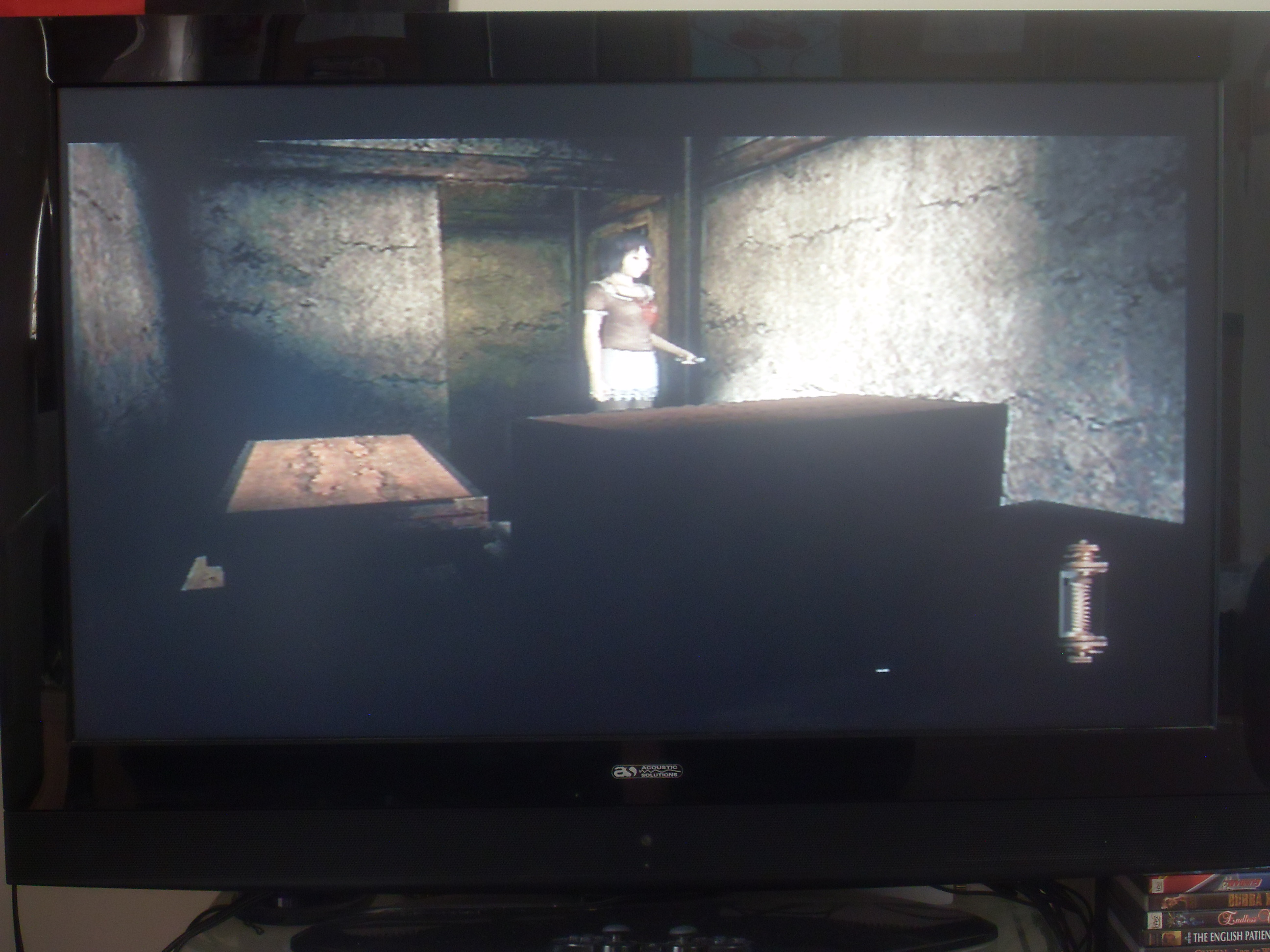
This door’s currently locked. However, you can see a small gap to the right of it that you can walk through, which is just a small closet. It has a very unfriendly camera angle:
Project Zero 2 camera and composition

Storage room.

There’s not much room to walk around in here and Mio is fairly obstructed by all the boxes in storage. It’s not a kind space. But what’s especially noteworthy is this tiny cluttered area is where you’ll pick up ‘film reel 6’. The projector room is not five feet away so chances are you’ll want to pop back in and give the film a watch.

Before you do, let’s see what else is in this area. Passing the door to the projector room brings you to a staircase.
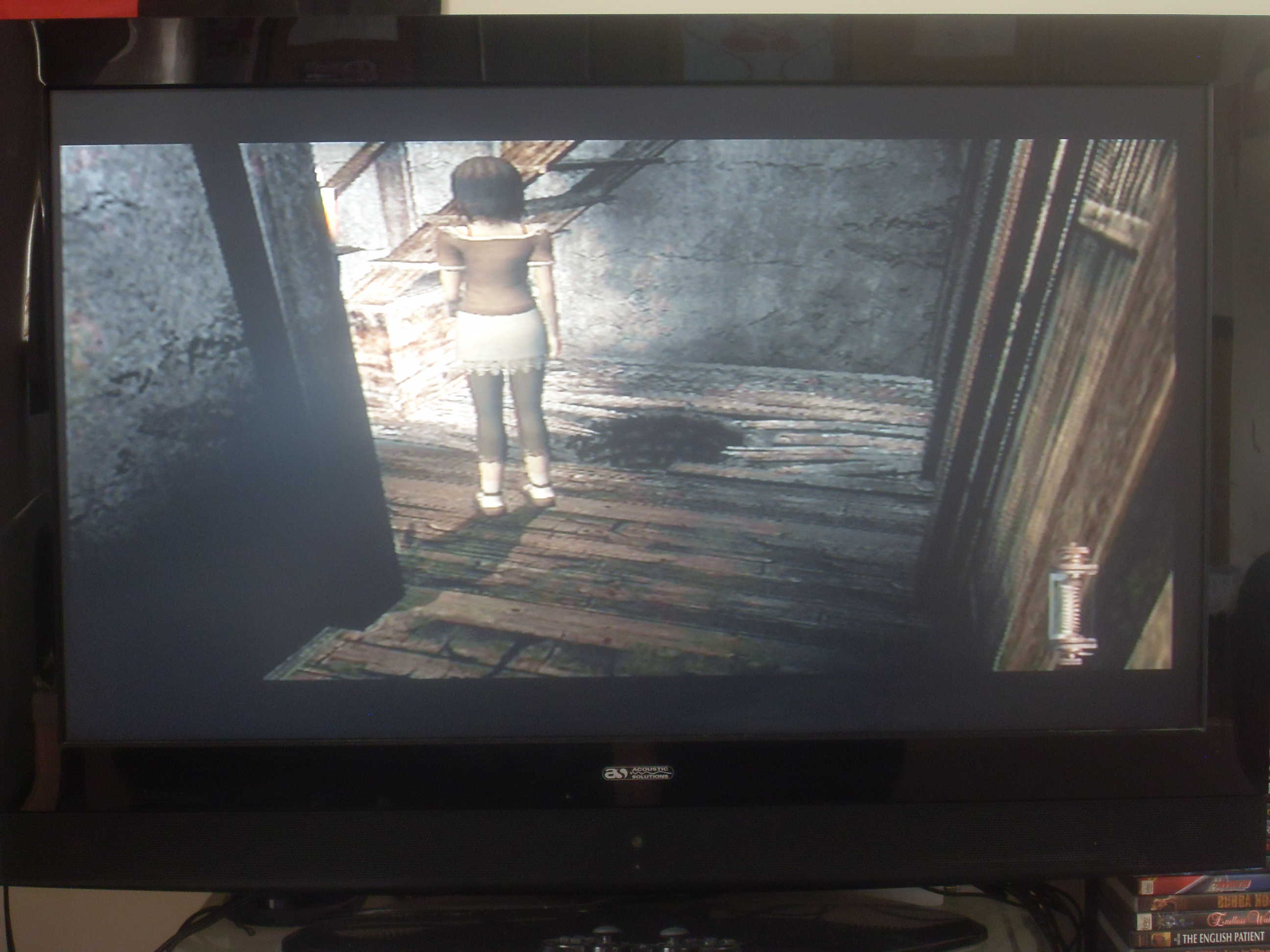
Project Zero 2 camera and composition

And underneath the staircase, behind some broken floorboards…

Project Zero 2 camera and composition

…Is a well. If you’ve seen Ringu the hairs on the back of your neck might be standing on end—a boarded-over well was the final resting place of vengeful spirit Sadako, whose modus operandi was to crawl through the television screen of whoever watched a certain videotape to kill them horrifically.

Project Zero 2 camera and composition

Sure enough, spooky wells have somewhat recurred throughout Project Zero 2 so far as places of murder and tragedy. Finding a well buried underneath the Tachibana house is deeply unsettling, even as is.

But it gets worse.

I’m going to interrupt the flow here to point out something about the last picture. As I said earlier Mio has a camera obscura with which she can defend herself against ghosts. Since equipping the camera gives us a first-person perspective of our surroundings complete with full directional control, we can actually use it to get around the compositional trappings of the second-person perspective at any point in the game. In this case, for instance, we need to equip the camera obscura to get a proper view of the well.

We can also use it to see what the storage room looks like from a different vantage point. It’s full of boxes.

Project Zero 2 camera and composition

The camera obscura seems an incredibly valuable tool, so of course it has a downside. When we’re holding the device we lose a lot of Mio’s mobility—she takes forever to turn and look around and she can’t run. Add to that the extremely limited peripheral vision the camera allows us and it becomes clear it’s a glass cannon: great offensive capabilities but we become fragile.

For this reason the camera obscura is best used in combination with the second-person perspective rather than functionally supplanting it completely.

Anyway, now we have the film reel 6 and we’re on our way to view it, so we return to the projector room and slap the reel in the machine. The footage starts up on the screen.

Project Zero 2 camera and composition

The film shows a storage closet lightly packed with boxes, not terribly unlike the one we just visited. After a few motionless seconds pass, the lid of one of the boxes lifts an inch and slides down to the ground. From the cavity stirs a figure, first its head, then its arms raise into view and extend to the floorboards as the body pours out after it. The film scrapes and cuts briefly. The figure emerging from the closet janks its limbs forward and crawls towards the screen, towards the camera, moving closer and closer right up into the foreground. The projector cuts out. The film ends there.

With Ringu fresh in our minds, we crumble.

There is no good position from where we can watch this film. In shot 3 Mio is standing right up against the projector screen; with the angle of the camera, the figure on the film moves directly towards us the player. In shot 4 we have some distance but the figure’s path would have it exit the screen at the exact point obscured by the projector.

Project Zero 2 camera and composition

If we stand in shot 1 and watch the film through the camera obscura, we lose sight of the entire rest of the room. And shot 2 would have us standing right in front of the large, undulating curtain, behind which, on the other side of the wall, is that well.

Regardless of where you position Mio when viewing the film reel, it makes for a terrifying experience. There is no getting around that. When the projector cuts out and the film ends, nothing actually jumps out at you. Not from the screen, not from the curtain, not from the walls or the floor. The rising terror from the figure’s haunting approach lingers in the air unresolved. It would almost be better if something did jump out at you just so the moment would end.

If you gather yourself up and continue on with the game, you’d have to take the door on the northern wall again. This will take you to the staircase over the well and up to an area I haven’t yet dared to venture at the time of writing this. If while up there you decide to turn tail and backtrack to a savepoint, you may end up passing through the projector room again.

Remember now that the shortest and easiest way to make your way through it is by running straight in front of the projector screen and being visually disrupted by the projector itself. And every time you enter this room the film reel currently loaded in the projector starts up automatically, playing that accursed footage again, perhaps with a new twist.

At this point in the game I decided I had my fill of its tension for the time being and chose to head back to the nearest savepoint. I turned off my console, plugged it out of the wall and called it a night. This was the last time I played this game.

I did have plans to resume it later that week, however. I had set up the console, loaded up the game and turned off all the lights in the house. But as I stood at the hall door waiting for my eyes to adjust in the pitch blackness, my adorable little kitty cat ran up to me and touched my leg. And scared the shit out of me.

Project Zero 2 camera and composition

mew

That was a year ago. I’ve not gone back to the game since.



This Week We Read: 26/10/14

Each week I ask a group of peers, colleagues and strangers to share with you some articles they read over the previous seven day as described in their own words. The articles they contribute might be a day old or a year old, they can be highly academic or light as a feather, they can be noteworthy for their originality of perspective or they can be utterly, delightfully derivative – the only criteria is for their pick to be at least faintly relevant to people who might be interested in videogames.

My guest contributors this week are Sara Byrella, John M. Osborne and Carli Velocci. If you’d like to volunteer as a contributor for next week’s post, you can contact me on twitter @stbeirne. Now, for articles on ASML Let’s Plays, Alien: Isolation, and bad Final Fantasy fashion, on with the latest This Week We Read.

Sara Byrella, USA - Writer/Layabout; @umbyrella; sarsbyrella.tumblr.com

One of my most enjoyable, moving experiences this year has been Ice Water Games’ Eidolon. Apple Cider Mage explores the escapism she found in its sense of isolation and minimal investment in the player character’s physical being. Meanwhile, Jack de Quidt reflects on the process of coming to grips with its world and the many stories hidden within it, as well the narrative that emerged from his bewildered note-taking.

Emily Short briefly discusses Elegy for a Dead World, which expands upon the richness of de Quidt’s journal-scribbling trek through post-people Washington by asking players to write their own stories with minimal prompting and gorgeous, barren landscapes as their guide. She makes note of Elegy‘s potential limitations as well as the possibilities afforded by Dejobaan’s experimentation with narrative.

Lilith talks about the grimy, beautiful settings of her games, among them Crypt Worlds (referred to lovingly as “the piss game”), and how they came to be. Spurred on by anxieties not unlike those brought up in Apple Cider’s piece, she’s made a home for herself and her creations amid the dirty, unloved margins confining her throughout her life.

Janine Hawkins provides a primer on ASMR Let’s Plays and the ASMR phenomenon in general by engaging some of the scene’s participants. They share their thoughts on the stress-alleviating nature of these videos as well as the negative or confused responses some viewers have to their unorthodox contributions. Also remarked upon is the unprecedented array of video game media options now available.

John M. Osborne, American Expat living in Germany - freelance video editor and writer; @jmarquiso; co-creator of “Late to the Game”; Creator of reddit subreddits /r/cahiersduludica and /r/pocgaming, mod of /r/truegaming

Marshall Sandoval’s Cynicism, Recession, and the Resurgence of Cyberpunk on PopMatters take a look at the return of Cyberpunk as a popular setting in video games, especially indie titles, and makes the case that the current political and economic climate is responsible. Quotes from game devs like Brendon Chung (Quadrilateral Cowboy, Thirty Flights of Loving), and writers like Austin Walker tell the story why the poor, bottom rung hero against the evil corporate conspiracy is so popular.

Cameron Kunzelman takes a critical look at Destiny on The Cage is Worms, arguing that Destiny’s Raid is Interesting Because it’s a Game (whereas Destiny itself is more akin to a slot machine). This grabbed me personally as someone with a gambling compulsion - most ARPGs and Borderlands style shooters are off limits for me as a result. I’m more compelled to play than enjoying the play. Separating the Raid from the rest of Destiny highlights this issue.

On Rock, Paper, Shotgun, Graham Smith recalled his rewarding and exasperating experience bringing a loose guild together in It Takes a Village: Wurm Online and the Value of Tedium. He writes a great ode to teamwork, and how the game inspired it in the loose collection of players in the free server they played on. A server with its own society, history, and even mythology (a large statue of a legendary player character can be found on the island).

Patrick Keplick ponders the player’s role versus the artistic intent of the designer by looking at The Very, Very Large Black Bars of The Evil Within. Aspect ratio may appear to be a small technical detail, but the size of the frame is something in film that a cinematographer would tightly control. So the focus on the black bars themselves brought to my mind how VHS pan and scan would compromise artistic vision for filmmakers - why not game designers? Especially in an age where players ask for multiple display options.

On Eurogamer, Jeffrey Matulef argues that Walking is the New Shooting. He looks at Alien: Isolation not as just survival horror, but also a bold statement about exploration as storytelling in games.

On The Game Critique, Eric Swain tries to Define Gaming’s Arthouse in his Non Play Criticism series. Using Kyle Kallgren’s “Brows Held High” - a film criticism video channel - as a jumping off point, Swain argues that what gaming needs isn’t better criticism, but a better understanding of basic criticism.

Carli Velocci, USA - freelance writer; founder of postmortemmag.com; carlivelocci.wordpress.com; @revierypone

The horror genre is one of the best at conveying the subtle characteristics of mental illness and Daniel Link’s article at Topless Robot on Alien: Isolation captures that in a very straight-forward way. Not only does he talk about his anxiety disorder (and as a sufferer myself, I like to support those who, in a way, “come out” about their experiences), but it also talks about symptoms in terms of that horror and wraps them all together.

Gita Jackson once again does a great job being one of the few people to talk about fashion and games in the same article. Her latest at Paste Magazine does a close reading of Yuna in Final Fantasy X-2 and how her outfit transition from one game to the next might be problematic (as if Square Enix’s outfit choices have never been questionable before). Jackson uses humor and her knowledge of the fashion industry to craft a truly unique piece that raises questions about artist intent and short skirts.

One of the most infuriating complaints coming from the movement that must not be named is the idea of keeping politics out of games. To answer those who agree, it’s impossible to keep politics and personal experience out of games. You can either listen to me or read this piece by Krish Raghav over at the Arcade Review. Not only does it provide an extensive history into Singapore’s political sphere, but it also seeks to raise an important point about politics in games: even the smallest artistic additions can in themselves be political statements.

Stephen Beirne, Ireland - game critic; NormallyRascal.com; @stbeirne; patreon.com/stephenbeirne

I was gently struck by Charles Beckett’s short and sweet post about the importance of a piece of art to comment on the relationship between the audience (/reader/player/etc.) and the world around them. Beckett’s angle is since we live highly digitized lives the art we currently make and enjoy ought to reflect the impact technology continues to have on our… well, he doesn’t get into specifics, but I imagine he might mean our self-perceptions, our ability to communicate and form interpersonal connections, our adjusted concept of being and reality and time, and on and on…. and that art that fails to approach these crucial subject matters risks death.

On Shut Up and Sit Down, Brendan Caldwell’s review of Dog Eat Dog is a fantastic read for anyone interested in ludonarrative directed towards social critique, in this case to showcase how colonialism ingrains insidious power dynamics in the social sphere to degrade and reinstitute the very soul of a community. It’s probably obvious that I had a strong reaction to Caldwell’s write-up on a game about colonialism; he grew up in the North of Ireland and I in the south, so although his is a far more severe and present experience of British imperialism, much of what he relates about lost Irish heritage still applies in large parts of the Republic.

And lastly, Mattie Brice rebuked the community at large for paying attention to women only when they are victims of personal harassment or systemic prejudice, and seldom if ever demonstrating an interest in engaging with their art outside of capitalizing on it. Brice remarks on the reality TV aspect of heeding women in games as idols soon to become martyrs for the benefit of public entertainment (or, the bloodsport of seeing women used as frontline infantry while our community ‘progresses’ towards a feminist future). Certainly there is a deeply ingrained capitalistic current that sees women as little more than solutions to fulfil the market niche of ‘diversity’ in our community, an exploitative packaging and assimilation of their art and identities which marks the prevalent disregard for the work of women outside of activism. Brice recommends some ways we can cease to keep women and their work at arm’s length, and thereby fulfil our claims to welcome them into the fold as people, rather than as political pawns.

Anarchic Terminal Life

Anarchic Terminal Life

Art and words by Stephen Beirne. This piece is community funded. If you like this article, please consider supporting my writing by visiting my Patreon and becoming a patron.

[Minor spoilers for Terminal, a game by Menesetsu.]

My favourite part of most sci-fi films is right at the start before the crew of the space ship stir to life.

In these scenes we’re given wonderful shots of the ship gliding through the empty blackness of space and interior stills of the control room and empty corridors and the med bay. Everything’s sterile of life and tranqui, the peacefulness of the interior defying cosmic indifference beyond the ship’s hull. We see the presently interchangeable crew members sleeping in stasis tubes, dreaming sweetly, trusting their lives to the protection of their metal eggshell. The air is silent but for the engine’s hum.

This serenity invariably breaks when a computer monitor flicks alive. Lines of text chirp across the screen, and like a contagion inviting movement and change, provokes whirling of further machinery each rousing one another to action. Code begets information begets interpretation, and so awakens the burgeoning of consciousness of computers and, in moments, their operators.

In seconds the quiet status quo crumbles and is replaced by chaos. The crew are ejected from their pods to address whatever minor catastrophe precipitates the plot.

It’s scenes like this just before we’re told of what disaster has befallen the crew that entice me more than anything, when the air is filled with so much potential. The delicate horror of the unknown hangs still unruined by the trite in-film explanation to quickly follow.

But within the tension extends the excitement of the mystery, the thrilling weightlessness, a craving for knowledge dangling on the other side of this heartbeat, and the exhilaration of feeling the threads of possibility coiling outwards as of yet unplucked. It’s a joy in itself, this hunger grasping for a reality to replace the broken one.

Menesetsu’s Terminal, a Ludlum Dare text adventure, suspended me here for hours. Truth be told, I’m a little stunned as to how it managed this—it’s giving me no small amount of trouble in writing this, since in articulating what Terminal achieves I find myself stumped by the contradictory fact that it is a horribly broken game.

In Terminal we play as a space station operator tasked with organizing traffic around our port. Although this is our job description, throughout the game we’ll only actually deal with one ship, so in the game’s present scenario this means waking the crew of the damaged Cygnus from cryostasis and ordering them via command line to prepare their vessel for docking.

Fantastic premise. So far so good.

The first screen we see tells us to type MAN for user instructions, which gives us a deceptively short list of possible actions, largely revolving around telling person X to do action Y at subject Z, and sources of information relating to the ship’s current state, such as the condition of each of its crew members, its navigation system, and the cargo bay. On the first day, the ERRORS screen warns us each crew member is still in stasis and since there’s a command to WAKE them we know straight away what to do.

From here it gets complicated. On the second day, our monitor informs us of the updated condition of the ship: the scientist’s gone mad, there’s a fault in the navigation system, and the captain is missing. Of our action commands we have HEAL X Y, REPAIR X Y and RESEARCH X Y, so for instance, inputting HEAL MEDIC SCIENTIST tells the medic to tend to the scientist. That’s one error down.

The problem arises in trying to figure out who should repair the navigation system—Cygnus’ technician, scientist or operator. We can only give each crew member one command per day and then we’ve to move to the NEXTDAY to see if our orders met with success. If we can’t repair the navigation system in three days, the ship crashes into our station and everyone dies. If we send someone an order they’re not equipped for, they injure themselves while failing to perform it and eventually die.

On the other hand, if we manage to fix the navigation system, we can strike it off the list of ERRORS and focus on the next priority. Every day there are new ERRORS—this is the worst built ship in the world.

This being the gameplay setup, the task for us as the player boils down to figuring out whose job it is to sort out each malfunction and mystery threatening the ship, accomplished by trial and error across several playthroughs.

As it turns out, it’s the PILOT who can REPAIR the SYS_NAV, but if we don’t get this on our first attempt we’ve lost our sole opportunity since the pilot goes missing on the third day. I never figured out how to successfully LOOKFOR missing personnel. Or rather, I never figured out how the game wanted me to LOOKFOR missing personnel, since in some playthroughs I did manage to locate both the captain and the pilot, only without the ERRORS screen copping onto this fact. Because the problem of the missing pilot was never ticked off the list it persisted well past the deadline, taking up screenspace that should have been dedicated to the next hazard engulfing the ship.

In this single example are two of Terminal’s gamebreaking flaws, which by their same nature are simultaneously its greatest strengths: our difficulty in using our console both to understand the problems facing the Cygnus and to communicate our commands to enact each solution. It’s through its bugs and design errors that this game repels the player, trending each scenario into a hostile, frustrating struggle with our extended cyborgization via technological interdependence, although I bristle at indicting these qualities as failures on the game’s part given the thematic cohesion they bestow.

What we experience is a multi-channel communication breakdown between the game and ourselves, to the same tune of the catastrophe now facing the crew of the Cygnus. A network forms between the four parties within this narrative: the Cygnus, its crew, the player as operator, and our space station console. A compositional analysis shows the console embodied visually on-screen as an in-game entity; the operator’s terminal is a component of Terminal, not Terminal itself, and in this lies our first hint towards the game’s insinuations on technology.

Mechanically it becomes a game of functions: as operator it is our function to collate information given to us by our console and interpret from them commands; as crew it is their function to enact these commands, resulting in feedback (crisis averted or crisis continues); as ship the Cygnus’ function is to be repaired and maintained by its crew and communicate its status to our console; as operator’s station our console’s function is to interpret the Cygnus’ signals into ERRORS and relay our instructions back to the crew.

Both operator and crew are reliant on an obtuse mediator to relate to them the problem being faced and the paths that must be taken to solve it. We are to the crew of the Cygnus as our monitor is to us—the honeyed twist is in becoming a computer to the Cygnus crew, we inherit a profound inability to comprehend We are the human manifestation of the Chinese Room. A meadowed android.

The beautiful cycle of mutual reliance transforming each party into cogs in an incomprehensible machine is not lost on Terminal—hence the digital command line nature of our communication with the Cygnus’ crew. By this way the four parties are layered as relational agents in a distorted hierarchy, dehumanising the Cygnus crew by use of the machinery dialect and dehumanizing ourselves through functional and thematic simpatico with our console.

The frustration this breeds when time and time again the Cygnus crashes home, time and time again our misapprehension is definitively proven, is for us the face of cosmic terror, where in the depth of space nothing becomes knowable. So cursed by our ineptitude at solving the crisis onboard the Cygnus, knowledge of the origin of its trouble evades us, perpetually postponing the moment of realization which would normally put an end to our fear of the unknown.

Ironically, over the course of all the hours I played Terminal, this suspended state of chaos and confusion eventually becomes the norm. Inside the pangs to decipher it and solve the mystery of the Cygnus, I found a slight sense of peace in the reverberating hum of my terminal and its echos of radio static.

And I quit.

This Week We Read: 19/10/14

this week we read 2

Each week I ask a group of peers, colleagues and strangers to share with you, in their own words, some of the articles they read over the previous seven day. The articles they contribute might be a day old or a year old, they can be highly academic or a nice light read, they can be noteworthy for their originality of perspective or they can be utterly, delightfully derivative – the only criteria for contributors is for their pick to be at least faintly related to videogames.

Our guest contributors this week are Corey Milne, Lana Polansky and John Kilhefner. If you’d like to volunteer as a contributor for next week’s post, you can contact me on twitter @stbeirne. Now, on with the latest This Week We Read.

Corey Milne, Scotland - Freelance Writer; coreymilne.WordPress.com; @Corey_Milne

With Gamergate’s bloated carcass still spoiling my view I thought I’d share this interesting little piece by Maria Popova on how Kierkegaard explained the psychology of bullying long before internet trolls existed.

Alex D. Jones talks about the surreal dreamlike pleasures of driving at night by comparing how both Glitchhikers and Euro Truck Simulator 2 evoke a feeling of “sonder”.

Ed Smith seems to be as enamoured with Alien Isolation as I am. He explores how the innate level of detail given to the world’s portrayal of cold utilitarian technology, makes it seem like a real living space. He’s bang on the money.

Aevee Bee talks about loss, pain and if there was anything you would remove from your being, given the chance?

Finally being a wee bit of a historian, this piece by Peter C. Earle comparing the inflation in Diablo 3 and the Weimar Republic is super stuff. This piece stuck with me a while ago because it actually made economics kind of interesting.

Lana Polansky, Canada - Art critic and designer; SufficientlyHuman.com; @mechapoetic; patreon.com/LanaPolansky

Liz Ryerson published a revised version of her IndieCade talk on her blog, in which she takes cues from Videodrome and The Pervert’s Guide to Ideology to discuss confronting ideology in games with her typically incisive prose.

Austin C. Howe deconstructs certain assertions implied in the dismissal of meta-games like Spec Ops and The Stanley Parable and takes a moment to discuss the importance of intertextuality to games criticism.

Jack King-Spooner identifies the infantilization and irony of games as a post-modern crisis and suggests some philosophical alternatives.

John Kilhefner, USA - Freelance Writer; jkilhefner.contently.com; @jkilhefner

In the realm of play, Brendan Keogh played Alien: Isolation and was often struck by its emergence and lack of “gamer-friendly” content.

One of our contributors this week, Lana Polansky, explored interactivity in a medium often viewed as impenetrable- poetry.

Over on Tubmlr, Secret Gamer Girl collects accounts of harrassment, and the results are telling:

“Almost none of these stories are things any of these women are willing to discuss publicly, because they know a sobering truth. The sort of harassment I’m about to get into never goes away, for anyone. It just dies down for a while.”

Stephen Beirne, Ireland - game critic; NormallyRascal.com; @stbeirne; patreon.com/stephenbeirne

This brief article Jennifer Justice wrote on grief and escapism is well worth a couple of your minutes, if only as a reminder that using games as a distraction can be dangerous to our wellbeing and limit our relationship with the world if not practised with care. I suppose a similar sentiment lies in Ian Bogost’s ‘Why Anything But Games Matters‘, a transcript of his recent Indiecade talk, albeit through a different, interpersonal scope: Bogost warns against isolationism in gaming as a cultural and creative space, advocating instead that we pursue interdisciplinary crafts and identities.

On The Psychology of Video Games, Jamie Madigan laid out the psychology behind two aspects of Destiny‘s loot system - one good and one bad.

Justin Keverne looked into the character of Vincent Brooks from Catherine and saw a frightful reflection of his own subconscious sexism, ingrained from 30-odd years’ worth of being fed the cultural idolization of masculinity.

Mattie Brice wrote about instrumentality in contrast to interpretation in terms of how mechanics take representational forms within the confines of a game. Using the examples of playing card, the five of hearts, versus a tarot card, the five of cups, she dissolves the often-touted line between functionality and symbolism to illustrate the limitations many games place upon themselves as an entertainment medium.

This Week We Read: 12/10/14

Each week, I ask a group of peers, colleagues and strangers to share with you some articles they read over the previous seven days. The articles they find noteworthy may directly or indirectly relate to games, they might be a day old or a year old, they can be highly academic or make for nice light reading - the only criteria for contributors is that they found their articles to be relevant and noteworthy.

Stephen Beirne, Ireland - game critic; normallyrascal.com; @stbeirne

Emily Short’s accessible and eloquent review of The Ascent of the Gothic Tower is a sharp thematic analysis supported by a rundown of developer Ryan Veeder’s authorial voice—the effect is an incisive narrative critique of The Ascent contextualized within Veeder’s work as a whole.

Katherine Cross penned this robust piece on the political underpinnings of Gamergate as a movement filled with internal contradiction, insofar as it lives and breathes by ghastly ideological puritanism while modelling itself on the same caricature of the ‘Social Justice Warrior’ it claims to oppose.

Elsewhere, Jaya Saxena has this wonderful breakdown of dynamics of sociability in Kim Kardashian: Hollywood. More specifically, Saxena illustrates how the game’s energy mechanics can be a useful guide to concepts of introversion and extroversion in the psychology of Carl Jung.

Jackson Tyler, UK - podcast co-host and writer. Follow him on twitter at @Tylea002 or find his work at abnormalmapping.com

A well written, exasperated article by Caroline Petit largely devoid of criticism as the glaring absurdities and problems within Shadow of Mordor (and other such games of its ilk) are so obvious, persistent and saddening that critique is self evident.

Lex Tyler wrote a piece from all the way back in April, which I stumbled upon earlier in the week, simultaneously a damning indictment of the state of the portrayal of queer relationships in games and a love letter to interpretation, on how important and hopeful it is that queer players are able to see themselves in the spaces the designers don’t fill in.

I love this short Amy Dentata article because it’s an encapsulation of a momentary thought, all questions and no answers, of someone going through the process of putting out a game. The ‘hype machine’ is inherently dehumanising, so writing like this about the affect of making yourself a cog within it is vital.

Ethan Gach, USA - currently blogging at Gaming Vulture and elsewhere. See him anticipate the post-human future with gusto on Twitter at @ethangach

As more videogame developers leap over one another to include multiplayer modes in all of their creations, no matter the genre of fundamental structure of the game itself, what saddens me isn’t that multiplayer driven games like Destiny or Dota 2 will become more prevalent but that, in time, they will come to monopolize the scene altogether. Michael Thomsen’s analysis of the nature of online play helps explain why.

Oniadh writes a somewhat esoteric but extremely thorough post that contrasts how the Fallout and Tomb Raider series approached norms of sexuality in games. It’s worthwhile reading for anyone interested in how games can play off of and subvert existing normative expectations in videogames that are otherwise constrained by the expectations which accompany larger development budgets.

With the release of another Borderlands just around the corner, it’s worth reconsidering a number of the controversial character portrayals from the second game. Earlier last month, Todd Harper expanded at length on how the game tries (and sometimes fails) to eschew conventional, idealize representations in the context of over the top comedy.

Zoya Street, UK - freelance historian and journalist; zoyastreet.com; @rupazero

Early this week I was reading some fan analyses of Star Trek‘s utopian image of the future. Is a future with no money, where people simply pursue interesting activities in order to better themselves and others, necessarily communist or socialist? I started at this wiki page, and then Raph Koster forwarded me to these two more detailed articles on the subject: The Economics of Star Trek and That Star Trek economy thing.

Speaking of less utopian worlds, Rob Fahey (full disclosure: a colleague of mine at Gamesbrief, though we didn’t collude in this article at all) wrote an excellent piece in which he points out that corruption is a flow of power or money that cannot come from people are largely powerless and impoverished, such as indie developers and games critics.

This interview with Marcus Novak in 1995 gives us a way into thinking about digital media in general and cyberspace in particular as “liquid architectures” - fluid spaces that shift according to their use. The idea had been introduced to me in a conversation with friends about the current state of our online spaces, and I’ve been really excited to explore the idea further.

I also finally started doing some course reading for my PhD this week, and the introduction to quantitative research has ended up being much more closely connected to games than I had expected. The introduction to Chance: An Informal Guide to Probability, Risk and Statistics by Brian Everitt acts as a great overview of the shared history of games and fortune telling, both being numerical ways that world cultures have managed uncertainty with dice and cards. For a few months now I’ve been thinking about how games are closely connected with fortune telling, and it was great to see that so clearly in this book.