Final Fantasy VII: Camera and Composition - Part 1

Final Fantasy VII: Camera and Composition

This piece was originally published exclusively to patrons on the 29th of November 2014 before being made available to all readers one week later. I intend for this to be the custom for one of my articles every month. To gain access to such patron rewards and to help make sure more articles like this exist in the future, please consider visiting my Patreon and becoming a patron.

Part 1 | Part 2 | Part 3

A few weeks ago I gave a compositional walkthrough of a single room in Project Zero 2 – the projector room of the Tachibana House – illustrating how the game’s use of camerawork depicted an environment which is subversive of safe spaces.[i] Since Project Zero 2 is a horror title this meant highlighting the strengths of its use of perspective within the context of the game as a whole, which is to say how visualized or represented space translates to perceived dangers and securities.

Another game that uses a second-person perspective[ii] to wonderful compositional effect is Final Fantasy VII, with a ‘cinematic’ reputation that’s lasted the nearly twenty years since its release. This longevity is justified—even as children most of us wordlessly understood how its stellar use of cinematography contributed to the experienced narrative.

What I’d like to do today is revisit FFVII with this particular mechanism in mind, to glance composition off against storytelling for perhaps previously unnoticed nuances (at least, unnoticed from my own perspective). It’s worth stressing that it is a mechanism: the use of camera to frame and juxtapose characters, actions and scenery relates conscious decisions on behalf of its creators. Simply the very nature of modelling its pre-rendered backgrounds[iii] establishes how fused they are with intention—our visual relationship to the world is so fixed to narrative design that camera and scenery nearly become one thing.

Since it’s best not to assume everyone has played the game, a little bit of exposition is warranted. The story of Final Fantasy VII focuses on Cloud, an ex-military mercenary who at the game’s beginning is working for the eco terrorist group AVALANCHE in Midgar city. Nearly the entire world is under the rule of the Shinra Electric Power Company, owing to its monopoly on Mako energy, an oil analogue. The corporation/world-government’s highly industrial and capitalistic structuring has lead to widespread social oppression, together with its mining of Mako, the planet’s lifeblood, informing AVALANCHE’s resistance. Initially Cloud is only in it for the paycheck but before long the fight against Shinra connects back to an old personal adversary and war buddy, Sephiroth, whose own designs for humanity spell catastrophe.

Final Fantasy VII: Camera and Composition

Figure 1

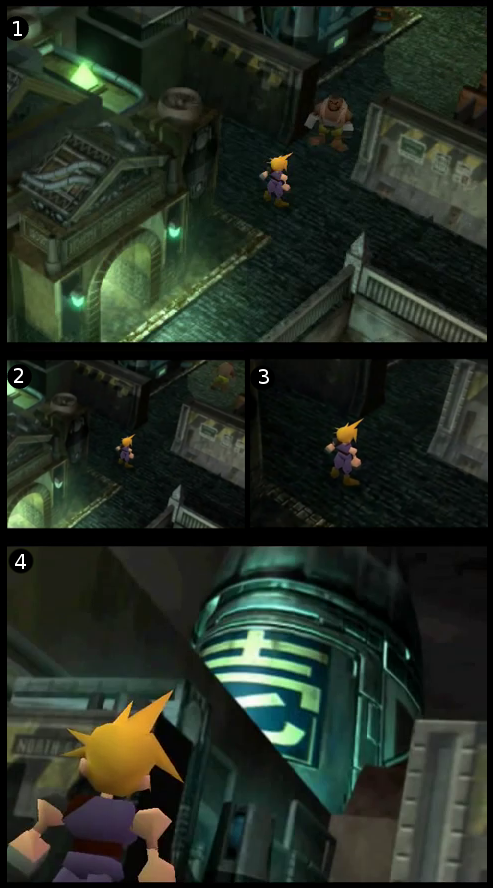
So two fairly clear-cut examples of FFVII’s deliberate camerawork occur quite early on. The first is not ten minutes into the game: Cloud and co. are infiltrating the Sector 1 Reactor on a sabotage mission, and after Barrett tells the player-through-Cloud what’s what [fig. 1.1], the resistance group continues toward the reactor while Cloud remains immobile [fig. 1.2]. The camera descends towards him from its isometric position before swooping around his back and tilting upwards, showing us AVALANCHE’s looming destination [fig. 1.4]. Cloud then hurries on to catch up with his crew.

This simple camera movement does a couple of things for us quite effectively. The most obvious is that it shows us the reactor we intend to send sky high, the enormity of which conveys magnitude and severity onto AVALANCHE’s terrorist action, while conversely characterising the group as rather minuscule.

A second effect is to approximate the player to Cloud’s position in relation to both AVALANCHE and the reactor (and implicitly Shinra): the motion of the camera towards Cloud offers intimacy and insight into his perspective. Bearing in mind this occurs right at the start of the game when we know nothing about anything, this slight connection with our character, however briefly, has a lingering effect on our perspective into the narrative. Continue reading →

Kuchera’s Fraying Seams

Kuchera's Fraying Seams

Art and words by Stephen Beirne. This piece is community funded – if you enjoyed this article or would like the artwork as a wallpaper, please consider supporting my writing by visiting my Patreon and becoming a patron.

“So a very odd thing was happening in the middle of this economic crisis, which was that capitalists had begun to talk about capitalism. It’s not often they do that because ideology resists an unmasking.”

Terry Eagleton - Why Marx Was Right, Dublin 2014

I am that much of a fool that I read Ben Kuchera’s recent article about the latest Assassin’s Creed. In spite of the fact that I more or less knew what I was getting into beforehand given how I plainly accept I am, to put it lightly, not a fan of his work, I still found myself in a rather unkind state of mind following the piece.

In it, Kuchera expresses the relief he feels at discovering Assassin’s Creed: Unity to be an unplayable buggy mess, such that it no longer binds him to go out and buy the game. It’s an unburdening, a release from one’s unspoken, self-imposed obligation, shared, Kuchera notes, by many fans of the series. The supposedly preposterous thing here and the reason it’s being presented as a curious twist of nature is people are glad they don’t have to buy a game from a franchise they’ve come to enjoy. They’re pleased to be able to write it off. It means they can move on to the next enormous franchise, as if a Metacritic score is the magic word to break their curse.

Now this isn’t a particularly original phenomenon nor is it intriguing in this case by its severity—there have been bigger technical and commercial failures in recent enough memory. Kuchera isn’t breaking new ground. What grabbed me is how he is describing a real social exhaustion with the status quo explicitly through concepts built to empower its continued existence, in that many people do feel stress and are actually relieved that they don’t feel compelled to buy Unity, but the explanation grasped here is the one most accessible to their projected mindset: a capitalistic solution to a problem inherent with capitalism.

So Kuchera glances over the frustration people are feeling to address it as an opportunity, using language friendly to a familiar capitalist framework: the issues we’re facing are budgetary (he has the dubious sense to attribute time as a resource but frames it as a currency to spend); the danger in buying a bad game is wasted money; our ‘identity’ as hobbyists informs the rate at which we must participate with media; our duty as “dedicated players” is to comply with mass consumption of media; the underlying assumption that we are responsible, by our own pleasure, to purchasing games as close to launch as possible; we ought to organize and schedule our leisure to justify keeping up with new releases to appease this responsibility; alternative games we could be buying are xyz from other equally hyped highly lucrative franchises. He conciliatorily frames this in the benevolent facsimile of consumer advocacy, an increasingly common way to present as progressive while pleasing one’s free market sponsors, or in other words, to say much and do nothing.

If this is the solution, the problem seems to be people are not yet epicurean enough. Not too terrible when put like that, except that the prospect of becoming more decadent, of achieving the objects of our desires (in this case, buying Unity), isn’t supposed to be daunting in and of itself.

Rather, in my experience, the sense of frustration isn’t solved when sated or when the item of affection is made redundant. It’s actually a condition of the very act of purchasing, which we are told from a very young age and all throughout our lives to be an intrinsically enjoyable act. It’s an economic deed to be treasured, to thrive off spiritually. The more prestigious the goods bought the more thrilling the exchange for its ownership—hence the importance on day-one purchases, and hence the crises of embargoes and pre-orders and Collector Editions and Elite Collector Editions, which stymie or galvanize the prestige. Normalization of this economic is instituted alongside a network of values also culturally ingrained to promote and safeguard its continuation, first by endearing the act to our worldly human existences, and second by convincing us of its necessity.

Thus the ideology is made self-fulfilling. Pursuit of the joy of purchasing is itself a wonderfully cyclic process in that all that’s required is to suddenly come into possession of an item to satisfy the Pavlovian conditions. To get this thrill from the purchase we don’t even need to consume the item, which is to say devour it and destroy it, although the language we use in describing that particular and distinct act is also deliciously capitalistic—we assimilate our possessions, they become a part of our spirituality, and therefore materiality breeds completeness.

Like language informing thought, thought informs reality. For those of us reared on the value of the act of purchasing, the simple act of it can have a soothing effect, observable in the wild and everything. We can enjoy it and we often do enjoy it; that’s why levelling up is so enjoyable in spite of its propagandistic connotations; that’s why it’s effective as propaganda. Just because it’s artificial doesn’t mean it’s not real, and just because it’s real doesn’t mean it’s natural. It is a fragment of the dominant ideology, and dominant ideologies are notoriously allergic to making themselves known, since in admitting themselves as constructs they acknowledge an alternative world without them. The lull we experience when faced with overindulgence and overconsumption (consumerism placing ‘consuming’ as synonymous with ‘purchasing’, as if the latter act itself is consumptive) reveals this artificiality—it’s a discomfort of cognitive dissonance, a seemingly spiritual emptiness when our acceptance that purchasing is fulfilling is unmet, when the promise of the joy of buying more and owning more fails to correlate with delighting more, and we cannot rationalize it as otherwise without contradicting a basic part of ourselves.

Which is why Kuchera’s article is compelling, because you can see he’s acknowledging a problem inherent to his ideology and the loops through which he jumps to resolve it in a compatible way without veering too close to pursuing the underlying thought. It is painful to tread that route, especially when it’s so much easier to grasp at air for opt-outs pre-installed in the status quo. If you track Kuchera’s work over the past few years you might find a gentle trend towards this level of self-reflection, perhaps ebbing toward substantiating his ‘changed man’ narrative since his shift to Polygon. As I wrote this post and left it to settle, hasn’t he gone and published a piece on ideology as a way to describe the Gamergate mania, complete with a video by Marxist philosopher Slavoj Zizek. But only after it’s safe to do so. He’s still bang smack in the capitalist mindset himself but it’s an encouraging sign.

This Week We Read: 16/11/14

Hello there you charming scoundrel, it’s time for another This Week We Read.

In case you’re new to these, each week I ask a group of peers, colleagues and strangers to share with you between three to five articles they read over the previous seven days. The articles they contribute can be a day old or a year old, they can be highly academic or light as a feather, they can be noteworthy for their originality or they can be utterly, delightfully derivative – the only criteria is that they found it interesting enough to recommend to you.

Previously this used to be a videogame-centric collaboration insofar as anything contributors linked to had to potentially be at least tangentially of interest to a readership that tends towards the medium of games. But since last week I’ve completely dropped this criteria – now contributors can suggest any piece of text from any field without needing to justify it to videogame-centricism. What I hope to achieve with this is to promote a healthy, outward-looking diet, rather than contributing to an ouroboric critical culture.

To this end, I want to emphasise that you don’t need to be a game critic (or a game-anything) to contribute to This Week We Read: we accept guests from any field or discipline.

Contributing this week we have Jed Pressgrove, Daniel Fries and Carli Velocci. If you’d like to volunteer as a contributor for next week’s post, you can of course contact me on twitter @stbeirne. Now, for articles on Advanced Warfare‘s button prompting, New York’s address system, and interviews with some of the best artists and creators in the business, on with the latest This Week We Read.


Jed Pressgrove, USA – video game critic; read his blog Game Bias, check out his reviews at Slant and Paste, or follow him @jedpressfate

Perhaps you have read some of the flimsy connections made between games and real-life tragedies in Ferguson and Gaza. Film critic Armond White avoids this sort of opportunistic drivel with Culture’s Clash, a piece he wrote in 2012 after James Holmes, citing inspiration from Heath Ledger’s Joker in The Dark Knight, shot up and killed people at a movie theater in Aurora, Colorado. White takes culture to town: “It is hypocritical to pretend that after years of celebrating sociopathy (as in Oscar tributes to such ugly characterizations as Charlize Theron in Monster, Denzel Washington in Training Day, Javier Bardem in No Country for Old Men, Monique in Precious, Ledger in The Dark Knight) that we don’t recognize James Holmes’ madness.” Because of this line and so many others (criticizing everyone from Roger Ebert to President Barack Obama), White’s essay is a provocative masterpiece.

Robert H. Dylan dismisses the critical commentary on Call of Duty: Advanced Warfare’s funeral scene in Press X to disrespect: Call of Duty Advanced Warfare. In his inimitable wacky style, Dylan explains why the “Pay Respects” prompt is “a perfectly harmonious example of naked, apocalyptic scale human hostility, innocently dressed up in its pious, militaristic, fascist propaganda jive of ‘freedom isn’t free’, ‘sacrifice’, ‘duty’ and ‘sincere emotional investment.’”

It can be difficult to shake the built-in urge to look at video games in light of its older cinematic cousins. Haniya Rae’s review of Hohokum, If Yayoi Kusama Designed a Video Game, is neither the first nor the last example of criticism that connects video games to non-movie art, but the relative accessibility of the piece makes it a pleasure to read. The lack of interpretation in parts of the review can be seen as a weakness, yet Rae’s approach favors criticism that goes beyond easy links between games, movies, and our subjective histories with these forms.

Daniel Fries, USA — Comparative Literature student; figurearcade.tumblr.com; @figurearcade

Sierra Tishgart interviewed a guy who has opened a bootleg Trader Joe’s in Canada. He’s careful to stay in the clear legally, but it almost sounds like he runs the business as a challenge, or a statement about his relationship to enormous food market corporations.

Ben Wellington’s blog about NYC Open Data remains one of my favorites. He’s able to use the data in really enlightening ways, and usually produces an attractive graphic while doing so. This week he wrote about navigating NYC’s address system, something I often find difficult.

Alive O’Connor talks about experiencing Porpentine’s new game, about creating identities and wearing them on our skins. I haven’t gotten a chance to play the game, but I’m intrigued by the mechanics that spread out into the physical world, and O’Connor’s article makes me excited, if a tad apprehensive, about how I’ll feel while playing, and afterwards.

Finally, I love Michael Brough’s blog post from this summer on the things that are really impossible. We seem to fight back against that idea, especially when we design games, and I think he covers how important it is to recognize impossibility—in math, in games, in our lives, etc.

Carli Velocci, USA – freelance writer; founder of postmortemmag.com; carlivelocci.wordpress.com; @revierypone

This isn’t one piece specifically, but I would encourage anyone looking to support marginalized voices in games to check out a series of interviews done by Jetta Rae over at Ravishly. She speaks with many of the most interesting game creators and scholars working today, including Lana Polansky, Soha Kareem, Mattie Brice, and more. Rae calls them a “resistance against #Gamergate” which is undoubtedly true, but they’re also a resistance against tradition, which is not a bad thing in a world as static as video games. I’ll link the interview to Toni Rocca, since it was the first one posted, but all are portraits of amazing people who don’t get nearly enough respect. Plus, it’s especially important in the wake of Gamergate that we lend support to those attacked by it.

Boing Boing ran a brief, but interesting piece this week about the history of social deduction games by Matt M. Casey. It works as a sort of beginner’s guide to the genre, but it also manages to introduce some thoughts about how we use time in play, creating different experiences based on old ones and developing our own in-game meta. It’s cool for board game fans, but it’s also enlightening for anyone who looks deep into the idea of “play.” Whole lot of questions raised in this one.

Despite never playing any Call of Duty games, I still find writing about it fascinating from the perspective of war. I find mixed reactions on how the series handles the realities of war and combat, which is why I liked Reid McCarter’s review at Kill Screen on the the latest game in the franchise. It provides a sort-of summary on the franchise’s relationship with war and how Advanced Warfare seems to almost finally recognize those problematic aspects. I’ve still heard some mixed statements on whether that makes enough of an impact, but seeing these kinds of discussions in the gaming space is probably a step forward, albeit a small one.

Stephen Beirne, Ireland – game critic; NormallyRascal.com; @stbeirne; patreon.com/stephenbeirne

As for myself, I didn’t do too much reading this week so I’ll start with a video. Maddy Myers’ talk at this year’s Boston AlterConf is available to watch online. She discusses how gonzo journalism is presently practised by some of the more esteemed outsiders of the games (and co.) industry, since insider groupies tend to think of its subjectivity as vile and frightening.

I wrote an article about identity in games this week and I came across this piece while researching. Sam Kabo Ashwell has an incomplete bestiary on all sorts of things relating to player agency, including aesthetic, self-insertion and cheating. It’s big and it’s interesting so give it a look.

For those interested in the area of race and media representation, Dr Zélie Asava briefing of her book The Black Irish Onscreen is a compelling primer. Dr Asava was giving a keynote address this week and screening short films at the Critical Mixed Race Studies Conference - hopefully it’ll be archived soon and we can give it a watch.

Lastly is Terry Eagleton’s review of two of Slavoj Žižek’s books, Absolute Recoil and Trouble in Paradise. Eagleton’s reading of Žižek makes for enjoyable insights easily attainable to non-academics.

That’s it for this week’s collaboration. Once again, if you’d like to volunteer as a contributor in next week’s post give me a shout on twitter @stbeirne. Mind yourself.

Framing Identity - or: How Can I Be Both Lee and Clementine

Framing Identity or How Can I Be Both Lee and Clementine

Art and words by Stephen Beirne. This piece is community funded - if you enjoyed this article or would like the artwork as a wallpaper, please consider supporting my writing by visiting my Patreon and becoming a patron.

[Spoilers for Telltale’s The Walking Dead seasons 1 and 2]

In my recent piece about Project Zero 2 I made a brief note that its use of a second-person camera perspective has a wonderful effect on player identity. I fairly left the point there.

We’re all familiar with the use of first-person and third-person perspectives in games, at least in terms of what that means for the camera’s location relative to player-character. It seems much less often that we articulate how use of either convention conveys a distinct sense of narrative direction, rather than merely visual perspective, in the same way as we accept the use of first-, second- and third-person perspectives denote the position of a narrator in relation to the reader/viewer/audience in other media forms.

Conventionally, stories told using these forms rely on addressing the protagonist with the appropriate pronoun—“I”, “you” and “he/she/they”, respectively—to ascribe a relationship between the text and audience. Games do something a little odd on top of that, since players often situate themselves within the world as a matter of course seemingly regardless of perspective. For instance, in first-person perspective games, especially those with a silent protagonist, the sublimation of narrator and player perspective suggests the player is altogether audience, protagonist and narrator, since we associate each role with “I” pronouns.

There’s a contradiction there continuing into the common language we use to talk about games. Typically a text using a first-person perspective differentiates between audience pronouns and protagonist pronouns—Goodfellas’ Henry Hill tells us he always wanted to be a gangster, but we are not Henry Hill. There’s a clear distinction between our identity as audience/listener and Henry Hill’s identity as character/narrator; we experience no overlap. Put another way, in this relationship our role as a participant in the text (people always participate with texts) is that of audience, not narrator or protagonist.

But in a game like BioShock Infinite, which also uses the first-person perspective, the distinction is dissolved via placing me in the role of Booker DeWitt, though not entirely eradicated, since DeWitt maintains a discrete identity disassociating him from me.

If we follow traditional narrative lingo, from the text’s standpoint in relating the player to the protagonist this would suggest BioShock Infinite is actually a second-person perspective game rather than first-person, contrary to common knowledge: if the game could literally speak, it might be phrasing its fiction as “You are Booker DeWitt.” It would also bring up difficulties in deciphering when a game is first-person and when a game is third-person, since even when playing in the third-person perspective players still use “I” pronouns to describe player-character actions and events.

This whole problem can be phrased in multiple ways, not limited to: Is the language we use to describe games inappropriate to our experiencing of them? When we say “first-person perspective” and “third-person perspective” in relation to games are we not referencing the narrative devices as they’re used in other media but instead some other novel phenomenon? What determines whether a game is narrated in the first-, second- or third-person?

Now, I’ve a bit of a soft spot for the ways we use language to put ourselves in a game so I don’t think we’re collectively insincere or misguided in how we use our pronouns this way; I think the confusion of identity is being generated and it’s not just a linguistic quirk. I also think our use of narrative perspective is not just imported jargon stripped of its traditional narrativistic meaning, that when we say “first-person perspective” we mean by it what it usually means.

Instead our identity confusion can be resolved by understanding the role of camera as (primary1) narrator separate from characters and audience, moving away from the theory of the camera in a purely functional sense as a mundane viewport for the player and towards perspective as a narrative tool simultaneous to being a visual tool. Same as in cinema, the camera is a representational device and what it represents constitutes narrative—it abstracts and contextualizes to produce meaning. And one of the functions of the camera as narrator is navigating player identity into the fiction. In this way our player identity at any given time is a relationship into which we enter through participating with the text similar to the concept of gaze: a process of incorporating the fiction of a text into our self-individuation.

Framing Identity - or: How Can I Be Both Lee and Clementine


A note of clarification is warranted at this point as to what ‘identity’ means in this context. Increasingly often when we speak of identity in games what we’re referring to is representation, as in the representation of social identities. This ties in with identity politics as the acknowledgement of group affiliations as being innately politicized and is followed through on by considering identity within one’s media analysis.

Often in part this is informed by a concept of ‘player identity’ as self-insertion: the popular line of thought that a player-character can, does or ought to serve as an avatar for the player. Character creation tools and customization can help facilitate self-insertion under this model, in that they allow the player to self-represent to their heart’s content (or more usually, until the customization limits are reached), as does organizing a game’s cast of playable characters with the intent of satisfying a diverse playerbase seeking to self-insert. Under this model, a player’s identity is therefore facilitated by a game’s willingness to represent various social groups.

Outside of sociology, another referent by ‘identity’ is its philosophical application defined as the relationship a thing has to itself, otherwise phrased as A is A, where ‘is’ signifies an ontological relation between the subject and predicate of the proposition.

My identity to myself is a tricky thing to pin down despite in practice feeling self-evident. For instance, if I am no more than my body, do I undergo a transformation of identity whenever I trim my fingernails or have a headcold? Is the virus a part of my identity, much like how my internalizations of cultural values seem to me (however foolishly) as inseparable from myself? Or am I, as phenomenologists might say, merely a bundle of perceptions somewhat removed from my materiality?

It is a very contentious subject. It’s so contentious there are even people who think it’s not contentious at all.

Anyway, for the purpose of talking about player identity here what I’m referring to is the metaphysical concept of identity rather than the sociological one. Although one’s social identity obviously plays a part in one’s metaphysical identity and can be a criteria in ascribing player identity, it is not a prerequisite for me to be able to identify as my player-character. There’s a subtle variation between the sociological and metaphysical application hinting towards these phenomena actually being two slightly different experiences—identify-with and identify-as, respectively. I don’t need to identify-with a player-character to identify-as them, or in other words I can experience embodiment without actually being anything like my player-character. If we allow these two sensations to belong to either field, identify-as would indicate relation whereas identify-with signals representation.

Understanding the camera in the role of primary narrator allows us to contextualize identify-as within its remit as a narrativistic function on top of its visual and mechanical functions, where applicable. This is not to say that visual perspective directly correlates to player identity. A player’s self-identification is the result of craft, a million interlinking threads, or two interlinking threads, which align for the player just right so that they experience that sense of embodiment. While (camera) perspective can facilitate that it is not a law of nature that it be so. Rather, what I want to emphasise is that perspective and identity form a relationship through their conjunction that the narrative experience exhibits. I am (not) Cloud. I am (not) Squall. I am not Captain Martin Walker.

So how for instance the camera frames a scene gives us insight as to the relational characteristics of our player identity. BioShock Infinite puts us in an intimate position with Booker DeWitt; The Last of Us displaces us slightly from Joel so that ours is an external perspective to his. This is not to say we necessarily identify less as the player-character in a third-person game than in a first-person one because of how the camera is positioned, but rather it describes the difference of relation between player and player-character on a case by case basis, the externalizing sensation of which may contribute to our confusion over the metaphysical location of our identity.

Let’s use an example to see this properly in motion. I’m positive this won’t have been a universal experience among players so please bear with me.
Framing Identity - or: How Can I Be Both Lee and Clementine

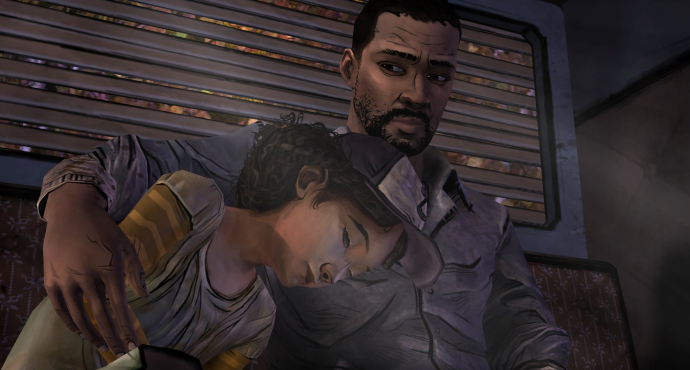
In the first season of Telltale’s The Walking Dead we played as Lee Everett who finds himself the ward of a young girl named Clementine. Over the five episodes of the season, a parental bond developed towards Clem both from Lee and quite a good number of the game’s players, to the point that the ontological distinction of Lee in his relationship towards Clem became negligible to them.

Well, Lee then died, and when the second season came around players then took up control of Clementine. Speaking for myself, it was at first not unlike a sensation of projected inheritance of Lee’s legacy and guidance onto Clem. Over a short space of time however, Clem shifted in her role from ‘daughter figure’ to ‘self’, in that my perception of her in relation to me changed appropriate to her newly adopted role as protagonist.

As if to complicate that, at the start of every episode Lee’s voiceover would introduce a ‘Previously on The Waking Dead’ segment, stirring up old feelings of parental identity which clash with my self-identification as Clementine.

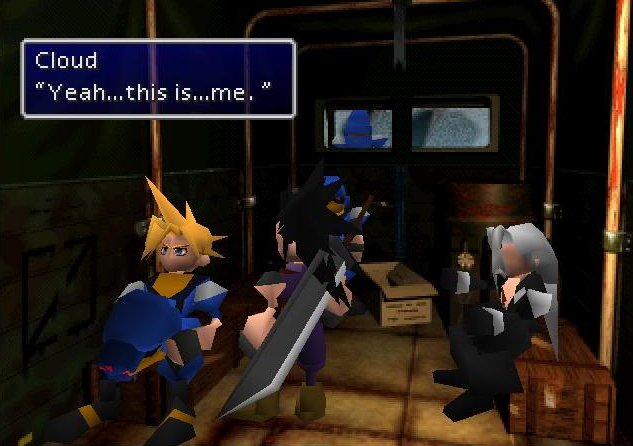
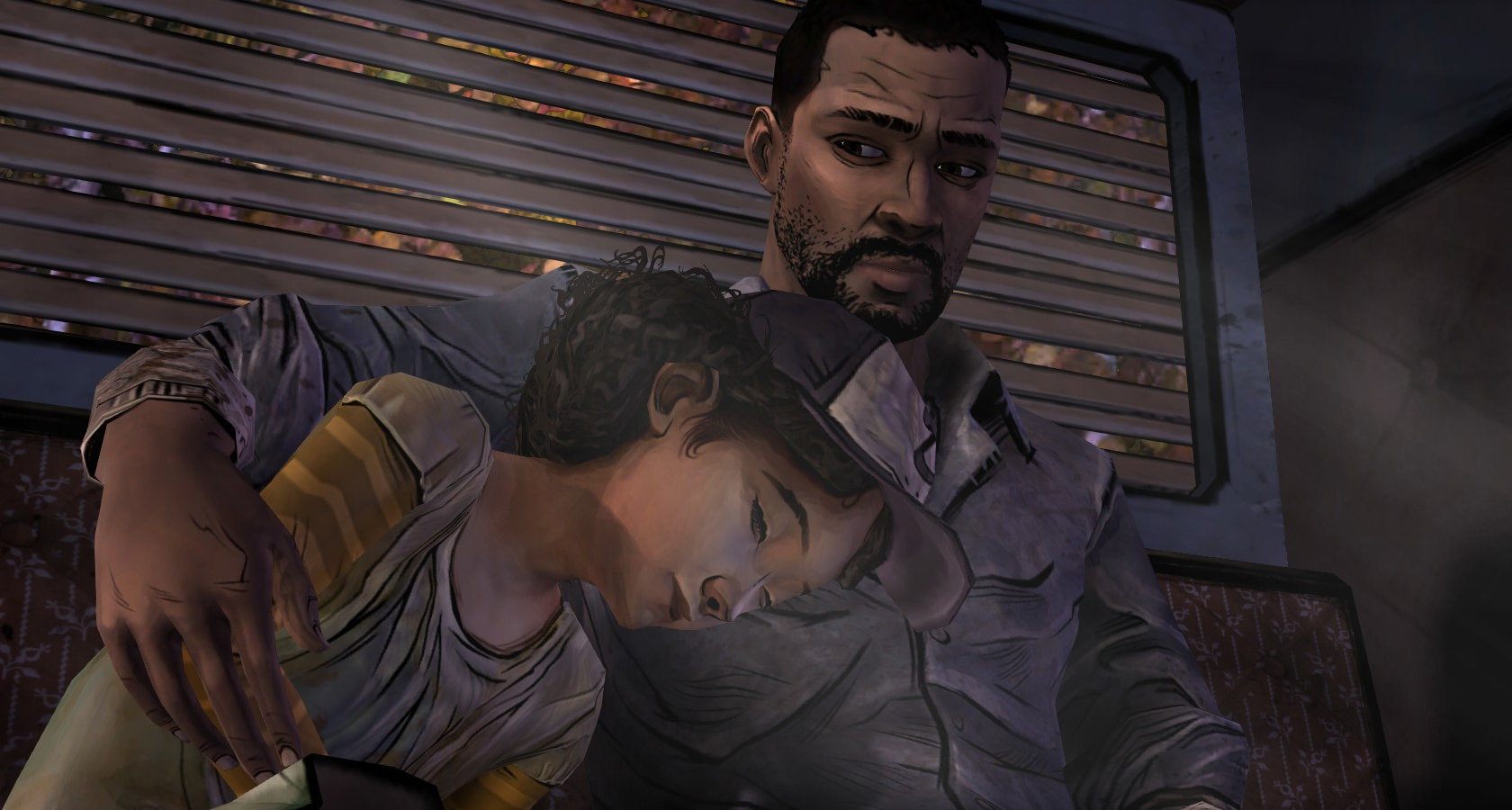
This all comes to a head in the final episode of season two when Clementine has a dream-hallucination that returns the player to a point midway through the first season, to a scene that never happened. Lee and Clem are in transit between disasters and Clem curls up to him for reassurance and guidance. Although during the first season this point in their journey felt chaotic, retrospectively it almost seems nostalgic to relive a moment with the old group, and especially with Lee, for delusions of stability and security it offers us and Clementine.

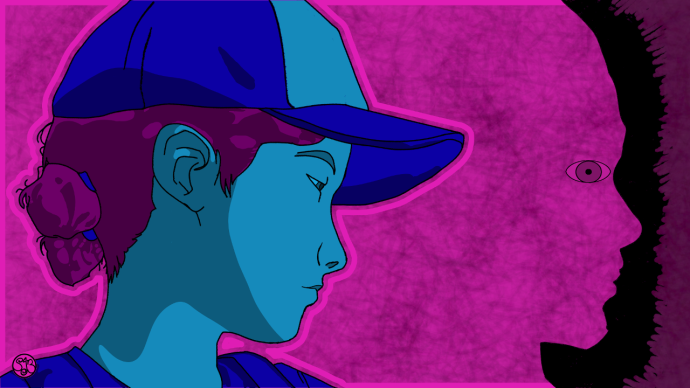
So through this scene I experienced a very unusual thing: I was at once Lee and Clementine in my mind, for my identity as Lee still lingered long after I’d lost control of him many episodes ago. As Lee I reflected on my impressions of the gameworld ingrained from the first season, including my parental bond towards Clem, and vague, naive hopes that everything would be OK, which then conferred onto my identity as Clementine as reassurance. But by facing this parental bond I acknowledged my identity as Clementine existing as another part of myself, so in that moment there grew within me a relationship between myself and another version of myself—my self-perception as Lee and my self-perception as Clementine. Each facet then shared across their relative perception of the other character so that I suddenly identified intimately as two characters observant of each other.

I became aware of the location of my player identity as a spectator to myself through the fiction of the game. Similar to Jacques Lacan’s theory of the mirror stage in a child’s development, this one scene bore identity consciously as a compositional technique of perspective, rather than through conceptual models of social representation.


1. With secondary narrator as, for instance, another character’s voice-over.

This Week We Read: 09/11/14

Well folks, it’s time for another This Week We Read.

In case you’re new to these, each week I ask a group of peers, colleagues and strangers to share with you between three to five articles they read over the previous seven days. The articles they contribute can be a day old or a year old, they can be highly academic or light as a feather, they can be noteworthy for their originality of perspective or they can be utterly, delightfully derivative – the only criteria is that they found it interesting enough to recommend to you.

In previous weeks this used to be a videogame-centric collaboration insofar as anything contributors linked to had to potentially be at least tangentially of interest to a readership that tends towards the medium of games. My hope in outlining such a loose demand was to encourage people to contribute (and read) outside of our usual tiny corner of the world, in order to advance an interdisciplinary model of game criticism curation.

From this week onwards I’m completely dropping this criteria - now contributors can suggest any piece of text from any field without needing to justify it to videogame-centricism. What I hope to achieve with this is to promote a healthy, outward-looking diet, rather than contributing to an ouroboric critical culture. (I do enough of that in my own writing.)

To this end, I want to emphasise that you don’t need to be a game critic (or a game-anything) to contribute to This Week We Read: we accept guests from any field or discipline.

Contributing this week we have Zolani Stewart, Jess Hyland and Dom Peppiatt. If you’d like to volunteer as a contributor for next week’s post, you can of course contact me on twitter @stbeirne. Now, for articles exploring sculpture as an artform, the self-imposed indie dev caricature, and sound design in Dark Souls, on with the latest This Week We Read.


Zolani Stewart, Canada - Games and Art critic, Founding Editor of The Arcade Review, @Fengxii

Last Week, the Abstract Critical twitter account linked a pdf of the April 1969 Issue of the Metropolitatian Museum of Art Bulletin, and in it is a short and sweet piece of writing on the sculptures and paintings of Jules Olitski. Dissatisfied with the limitations of painting, Olitski used sculpture to explore the foundations of color and surface, and the relationships within color and shape, or what Kenworth Moffett calls “shaped surface.” It’s an engaging read, and a nice gateway for anyone new to criticism on abstract sculpture. And it even helps my own thinking on videogames and their relationship to abstraction and abstract art.

Exteunt Magazine is my current fix for great criticism on theatre and performance art. One of my favourites is Catherine Love’s really expertful review of “An Enemy of The People,” where she explores the show’s own political contradictions, and how they reflect the almost ironic struggle between the intellectual dissatisfaction with capitalist culture and the middle class desires formed by that culture.

At Ricochet, Canada’s newest independent Left publication, Andrea Houston writes a *crucial* piece on the racism that was rampant during Toronto’s Election Campaigns, an issue mostly overshadowed by Jian Ghomeshi’s sexual abuse case.

And lastly, there have been some debates in the black intellectual blogosphere about the term “politically black” and its uses. Here is Nathan Richards arguing caution for the term, claiming that its use has been a tool for non-white non-black scholars to gain credibility in ethnic studies off the backs of black scholars who have less opportunity, and responding is the blog Native Species on how these claims are unfounded, and the assumption of identities trying to climb over others plays into cynical perspectives on identity politics. Obviously I appreciate these kinds of nuanced debates on racial identity/politics that go beyond what I tend to read in the U.S left writing. Here identity is acknowledged as more of a complex, nuanced space than it is a strict grid of identities that operate under strict understandings of how we think power works. It was somewhat refreshing reading it, so I encourage anyone interested to take a look.

Jess Hyland, UK - character artist; @floofyscorp; www.floofyart.co.uk

Cliff Harris’s description of the young, hipstery ‘indie game developer’ stereotype made me squirm a bit, but only because it’s so familiar. He’s raising an interesting point - are indies really as diverse as we like to think they are? Are we missing out on potentially valuable contributors to the indie games space just because they don’t fit the profile, because they aren’t accessible enough?

Have you ever come across a piece of fan-musings that paper over the disappointing elements of a work in a way that just makes you really smile? The total absence of dwarf women in Tolkien’s writings is something that always felt wrong to me, but these fans building their own interesting reasonings for it brightened my day right up.

I’m fairly sure almost everyone on Earth is sick to the back teeth of GamerGate by now, but this long, slightly rambling essay by Film Crit Hulk (which you may want to translate into sentence case with this tool) is heartfelt and somehow brimming with empathy for almost everyone ensnarled in the controversy.

A three-part article by Tim Schneider which is unusual, to me at least, in comparing trends in videogame art to those in fine art. Having never encountered my medium being taken quite so seriously before, I was delighted to read about the debate, both then and now, over the goal of visual fidelity versus aesthetic appeal. History repeats itself, in pixels as in paint.

Dom Peppiatt, England – games journalist - games™, SciFi Now; gamestm.co.uk, @dompeppiatt

John Hopson – a triple-A game design veteran and lead researcher for Bungie – writes about Behavioural Game Design back in 2001: an interesting read when you consider the majority of addictive qualities mentioned have been wrangled to fit into Bungie’s Destiny, over a decade later. A concise and clear breakdown of how developers see their audiences psychologically, and relevant in relation to how Bungie has managed to hook over 9.5 million players on its newest MMO-FPS hybrid.

Nissa Campbell gives a rundown of Red’s personal arc (Transistor) in Finding Her Voice, eloquently deconstructing what it is for a games writer to tinker with self-awareness and metafiction for a protagonist in a game that otherwise plays its narrative straight. Observed with a feminist slant and – if you want to read it a certain way – gaming’s obsession with the power of the phallic icon.

I also happened upon David Canela’s The Sound Of Dark Souls – a reflection on how the sound design/musical direction in From’s seminal action-RPG emphasizes the game’s structure. Describing how a binary musical skeleton and seemingly random rebellions against its own aural rules allows the developer to create an unsetting kind of dread you can’t put your finger on at first. Worth a read for anyone interested in psychogeography, in real or virtual worlds.


That wraps it up for the latest TWWR, folks. Once again, if you’d like to volunteer as a contributor in next week’s post give me a shout on twitter @stbeirne. Thanks for reading and have a good week.