
Thoughts on nearby covers

Thoughts on some covers - Alien Trilogy

This piece is community funded. If you enjoyed this article, please support my writing by visiting my Patreon and becoming a patron.

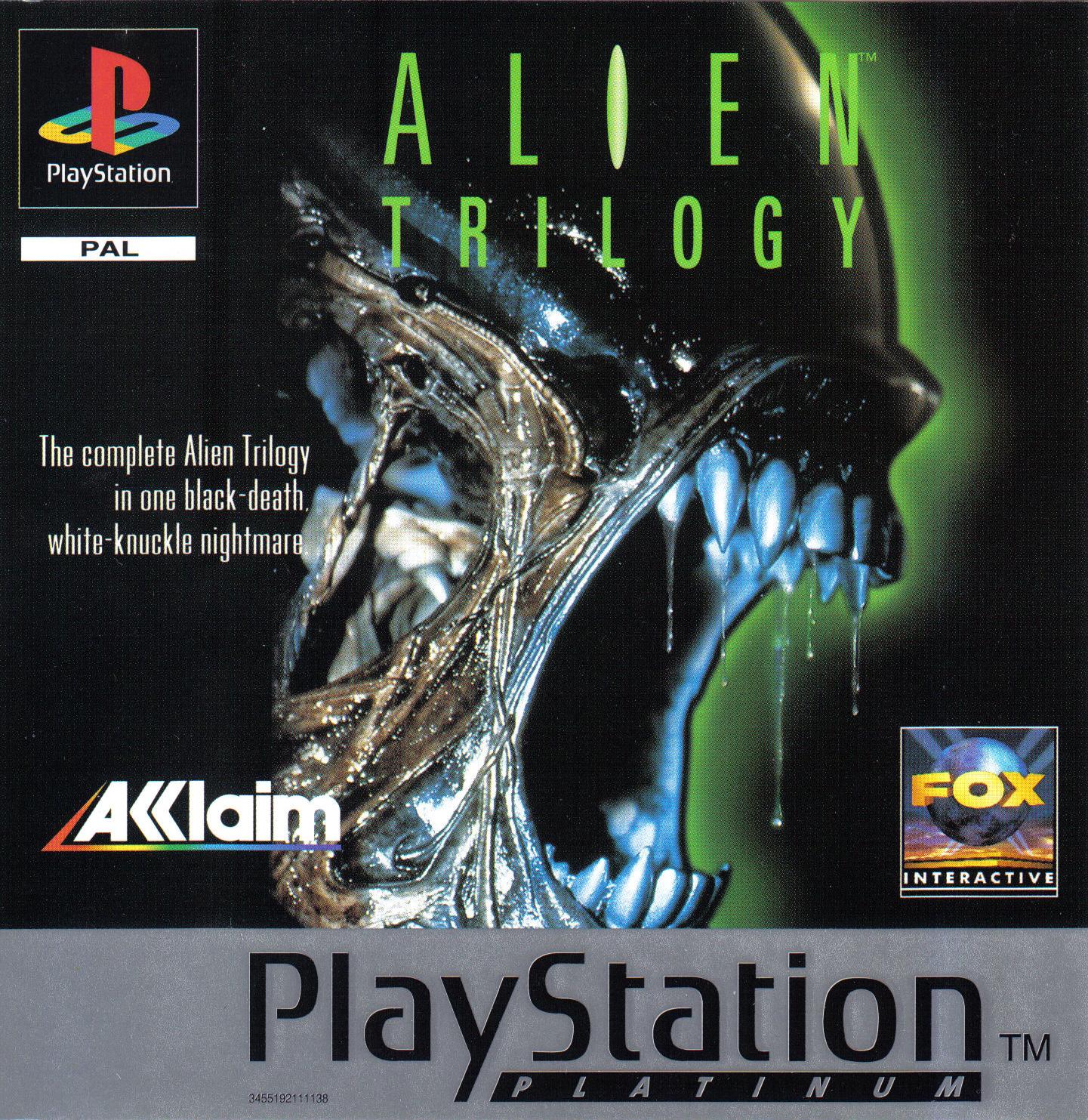
One of my most vivid videogame-related childhood memories is this. In July of 1996, my brother, the middle one, had done our mam no favours by asking for a copy of Alien Trilogy for his birthday. Despite the game having launched four months earlier, which in modern terms would have made it a hundred years old by July, nowhere in our area had any copies in stock. By which I mean, none of the three local video rental shops had it in stock, because this was Ireland at a time when the commercial exchange of games was a novel quirk and not a viable business angle.

Packed into the car were we for a rare trip to The Tallaght Square, famous in our minds for reason number one of being the only remotely accessible shopping centre in the greater Dublin area at a time before Blanchardstown and Liffey Valley. Reason number two for its fame was that it was pyramidal, not square, and this for us, pre-internet, constituted a joke whose humour was always worth revisiting.

So it was immediately a bit of a journey just to find this game, and when we did recover a copy in The Square, it felt all the more of a treasure. I’m sure there were other errands on that trip but my memory tells me it was the only thing we came away with. My brothers and I passed the box around for the long drive home, poring over the manual and delighting in anticipation of what the box cover suggested, foreboding the Alien’s imminent pounce. Once at home we put it on and certainly thrilled in the experience, but now I suspect I didn’t enjoy it half as much I did its prelude.

Perhaps it’s because back then we had fewer games and an over-abundance of free time that we would so patiently gorge on a game’s extra material like aesthetes at an art museum. Now, as I have no lack of the former but absolute lack of the latter, I seldom consciously dwell on a game’s cover as intensely as I used to. While I still variably note my appreciation for or dislike of any given box art, I don’t study what I enjoy about it and savour the anticipation or place it in context, beyond exceptional circumstances. I miss that.

So, with my limited vocabulary, I’d like to take a spell to put that sort of mindfulness to a platoon of games stationed at hand beside me, them dust-coated sentries what have kept me company these past years of working and writing. Continue reading →

Two Minute Game Crit - Zone of the Enders 2 and AI


This video is community funded. To support my work and help me make more of these, please consider visiting my Patreon and becoming a patron.

Transcript:

Hi, this is Two Minute Game Crit and I’m Stephen Beirne.

In a recent issue of Five out of Ten Magazine I wrote an article about the idea of technological determinism in Zone of the Enders 2. Technological determinism is the theory that a society’s forward direction is defined by the technologies available to it. Or in other words…

NOHMAN: “Since the dawn of history, Human beings have realised various forms of energy. Civilizations have progressed with them.”

I want to expand on this with regards to artificial intelligence, which crops up in Zone of the Enders through the characters of ADA and Viola.

So as you can see this is a hack and slash action game based around mech combat, and ADA is the AI installed in your mech.

KEN: “ADA, please look after him.”

ADA: “If I have to.”

She’s gas, and even though she’s clearly her own person, at the end of the day she’s still got it in her head to be subservient to humans because of her programming. Despite how some people encourage her, she doesn’t value her own life.

DINGO: “How can you throw away your life for no reason?”

ADA: “I don’t need a reason.”

On the other side of things is the Viola AI, a rabidly destructive machine modelled after the personality of a tenacious soldier named Viola. The AI’s a success insofar as it mimics her combat abilities, but totally fails to capture her essence.

Whereas the original was “immortal” through sheer force of will, the Viola AI replicates this passion for life through deceit – it’s actually just being mass-produced, not resurrected.

Here we have two different degrees of AI, one wholly synthetic, the other amalgamated from some abstract concept of humanity. In practise, the main difference between the two is the Viola AI is in every way a wholly vapid automaton, completely derivative, while ADA is an entirely new type of lifeform.

Viola is a zombie. ADA is a frontier.

Viola’s a T-1000. ADA’s a Tachikoma.

…One more.

Viola’s the Borg, ADA is Mr Data.

Now, unlike Shodan or GLaDOS, Zone of the Enders isn’t interested in framing AI as some harbinger of doom. Instead it’s much more interested in similarities, like the way humankind and AI-kind are equally suffocated by the militarism that results from technological determinism.

People like Viola are made as cogs for this relentless engine, and miraculous creatures like ADA are thought as void of sentience as the soulless Viola AI.

Now, if you’re not convinced that humanity objectifies itself by objectifying AI, just trust me. Because…

DINGO: “You should take time to worry about the meaning of your existence later.”

(Also)

DINGO: “I’ll get rid of it while you’re doing your homework at home.”


Video description: Continue reading →