[What follows is an excerpt from Final Fantasy VII: Camera and Composition - Part 2, which is presently available exclusively to patrons. This page will be updated with the entire thing in January. If you like what you see here and wish to support my writing while gaining access to exclusive articles and artwork, zoom on over to Patreon and sign up as a patron.]
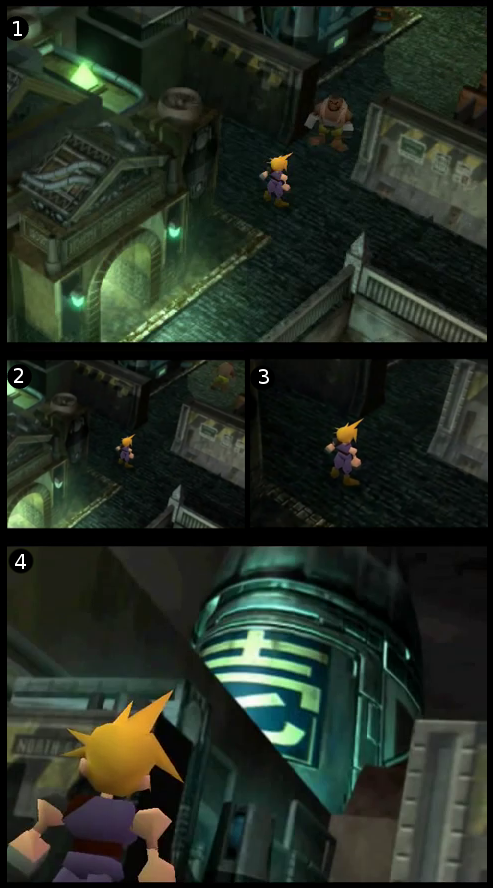
In Part 1 we went over some of the basic ways Final Fantasy VII uses camerawork and scene composition to thread its themes throughout your playthrough by relying on almost invisible cinematic techniques. We talked about how the ramshackle slums are represented compared to Shinra-designated areas to illustrate a gap between the classes of Midgar’s capitalism, and how positive, navigable space differs from one to the other in how they ask the player to relate to these areas in the intersection of mechanics and composition.
And we touched upon a theory about the use of symmetry as a signifier of existential contentment. We rounded off the piece by suggesting Shinra is commonly represented as existentially harmonious, fitting into its role as an oppressive capitalist organization which currently organizes the whole world according to capitalism and oppressing its people. Its existence suits its essence. Likewise, a clear early location of Aeris’ existential harmony is the Sector 5 church, Midgar’s sanctuary for the lifeforce of the planet and the one area that best encapsulates her narrative arc.
Now, we could spend another million words viciously dissecting every single camera shot to enjoy their juicy semantic innards and all without leaving Midgar. But it’s time to move on just a little bit to look at a particularly exquisite narrative sequence that I’m sure is fondly remembered by all who played FFVII in their childhood: the flashback to Nibelheim.
And where better to begin this analysis than… back in Midgar.
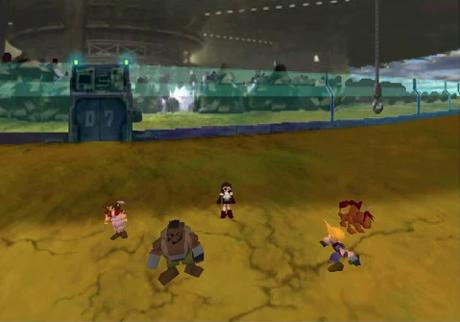
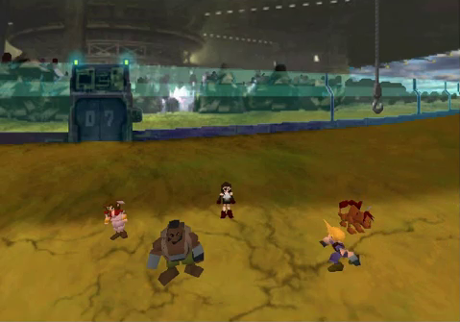
Okay, we’re actually on the very outskirts of Midgar. Cloud and company have just escaped the clutches of Shinra and rescued Aeris from her gruesome fate as a lab specimen, during which President Shinra met an untimely end at the hands of one ‘Sephiroth’. Along the way we picked up fan-favourite character Red XIII, so that’s good. We’ve ridden our crazy motorcycle and beaten the armoured tank boss, and now stand on the cusp of the great wide world beyond Midgar’s literal walls.
I quite enjoy this shot because it deviates slightly from what would become a tradition in Final Fantasy games: the beginning of an adventure into unknown territory. Typically you expect such a shot to occur on the brow of a cliff overlooking a beautiful expansive landscape, giving you a glimpse of the journey to come.
But here the party rests with their backs to the city of Midgar and we’re looking towards their faces (well, all except Cloud in this screenshot—he’s player controlled right now). While we can’t see the big open world they’re looking out towards from this angle, we can see them very clearly, which makes it an ideal angle for situating the characters as the focus of the scene and highlighting their past, here represented by an increasingly distant Midgar. Their future is unseen and unknown, whereas the past is accounted for as overcome (or at least escaped) ground. A bit of dramatic irony for returning players, here.
So in the fore- to mid-ground we have an abundance of positive space, for perhaps the first time in a non-Shinra-designated area, breaking off in the distance at Midgar’s looming, unassailable form. Even the colour palette suggests the future as brighter than that capitalist fortress.
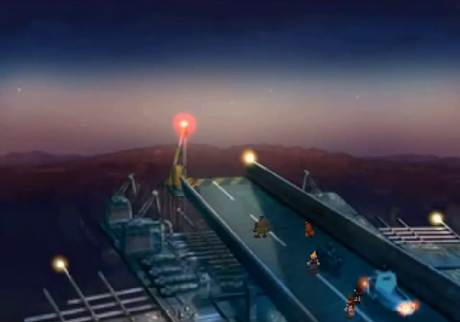
As it happens, we actually do get a shot on the brow of a cliff (well, a highway) overlooking a beautiful expansive landscape just after the boss battle.

It’s actually a wonderful environmental shot in spite of a few odd characteristics: it doesn’t really show us what’s beyond Midgar specifically, since the horizon is obscured by the trio of Midgar scenery, far-off hills and an as-yet young sunrise. Instead we get a general idea of what’s next in the journey, which is to say, not-Midgar. And secondly, although this is the bit where Cloud and Aeris state their intentions for the adventure, they come across on-screen as insignificant.
To be honest I’ve a more lasting memory of the alternative ‘Leaving Midgar’ shot so maybe it’s a personal whim of mine to find more to recommend it.
Anyway, moving on, the player organizes their party and exits through the foreground. If you make a party full of boys, Tifa and Aeris will both comment on your unusual choice before they set off together. Hopefully they’ll find something in common to talk about.
The next area is the world map but it’s compositionally dull so let’s go straight to Kalm.

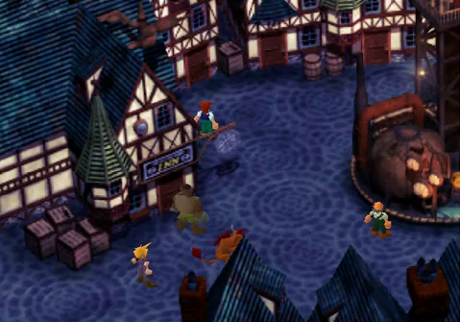
Kalm is a nice enough town. It adds a lovely shade of indigo to our encountered palette which is nice on the eyes. The architecture is rather distinctive but since this is a composition analysis I’ll leave it be. It’s somewhat of a well-to-do satellite town of Midgar, having profited off trade from the Mithril Mine further to the south-east as evidenced by through the shops’ inventories and various rare-ish items you can find about the place. And although the people here will never be the sort to join AVALANCHE they’re a hospitable enough bunch.
Anyway, this is the first place outside of Midgar we visit but we can see right away that it’s a townspace by the layout and the distancing and angling of the camera on the scene. The player can enjoy some downtime before meeting up with your party on the second floor of the inn to continue the story.
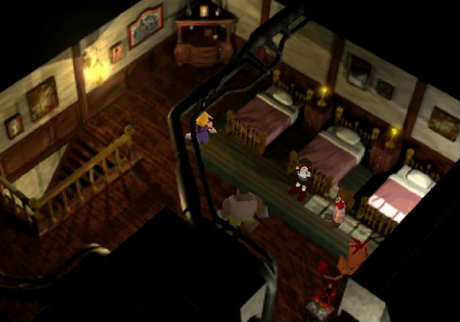
Aside from the reception area the inn only has one big room, which can’t be convenient if another party of adventurers were to show up. As luck would have it they never do. There are also only three beds but five party members. The game leaves their sleeping arrangement up to our imaginations.
This is the room where Cloud recounts what canonically will come to be known as the Nibelheim Incident, which he has decided is the best way to tell everyone about his relationship with Sephiroth.
You’ll notice the room is bisected by an awkward tangle of pipes running along the ceiling. It’s a common feature for indoor areas in Kalm, although this room might be especially bad for how they intrude into the scene. The pipes separate the room into two rough portions: the right side, where everyone has gathered to hear Cloud’s story, and the left side, from where Cloud enters the scene. It’s possible that the pipes are a total accident but this could be an attempt to discretely division Cloud from the rest of the cast, perhaps in apprehension for their present expectations of him. What’s a bit of trauma between friends.
I mentioned this in the last post but I’ll repeat it here because it’s a nice bit of choreography: when Cloud begins talking to the group he’s situated centrally on-screen, but as he sets the scene for the flashback he turns around and paces away from the group, stopping here:

Now the pipes somewhat obstruct him on-screen, so the distance he has placed between himself and the party is mirrored in our own relationship with him through our diminished visual contact.
We have been given reason to suspect Cloud’s mental state at previous occasions where he has spoken confusedly with an unknown other, usually in times when unconscious or asleep, but this nugget of composition goes quite a way to specifically colour Cloud as an unreliable narrator in the tale to follow and foreshadow the twists in his arc much later.
[…]
[Sign up as a patron by as little as one bob a month to gain access to the article in its entirety.]