Two Minute Game Crit - Weapon Degradation


This video is community funded. To support my work and help me make more of these, please consider visiting my Patreon and becoming a patron.

Transcript:

Hi, this is Two Minute Game Crit and I’m Stephen Beirne.

Weapon degradation. Lots of people hate it. This whole business of weapons having a durability stat that you have to monitor in order to stop them from shattering into a billion pieces. And this is considered disruptive. There’s the sense that, when weapon degradation is working it interrupts what videogames are normally for, which is hitting things with other things. And when it’s not working it’s because you’re putting in the busywork to keep the game from annoying you.

This is not universal. There are plenty of games that are remarkable for their use of weapon degradation, like Fallout 3 and Dark Souls and The Last of Us. You can see the trend there that these have narratives which centre on survival, and the world being banjaxed. We can tell when needless busywork or additional stuff contributes to a game on a whole or takes away from it. As always it’s all about what the stuff says in the respective context.

One of the best games with weapon degradation, one of the best games in general, is Vagrant Story, a wonderful, incredible jrgp dungeon crawler Square did between Final Fantasies once upon a time. It’s got this great big cast of characters but the protagonist, a peacekeeper named Ashley Riot, spends most of time alone as he’s a solo operative.

Instead of friends, he has weapons, lots and lots of weapons. Your life is consumed by the introspection of inventory management and stat planning.

For our purposes, look at the two bars on the top left here, DP and PP. DP is Damage Points, which decrease as you wear out the weapon, usual durability stuff. PP is where it gets interesting. These are Phantom Points, and they increase as you use the weapon. The higher both of these bars, the more damage the weapon does. When Damage Points reach zero the weapon becomes kind of a dud, but you can spend a weapon’s Phantom Points to repair its durability.

The narrative of Vagrant Story is all about themes of body and soul, balancing identity and power through self-sacrifice. So Ashley’s weapons are building up a phantom, a ghost, an identity, but the more of a sense of personality they get the greater the risk to their strength. They grow fragile.

This all contributes to the weapon’s other, highly important stats of class and affinity, which also change through use and also build up in each weapon a sense of character. And then you can make your own weapons out of parts and give them their own name to call them by. ‘Wand’ might not be the best example of that though.

So, Vagrant Story. A great example of how to do weapon degradation.

God’s Work

This piece is community funded. If you enjoyed this article, please support my writing by visiting my Patreon and becoming a patron.

Today over tea, Laura picked from my head with uncanny intuition the question most bothering me this week: “why do you write about games?” She didn’t need to clarify the peculiar thing about my writing about games, specifically that I only write about games. I don’t write about books or movies or cats even though I also enjoy these things, even though I am probably fully capable to that end. If cornered I call myself a media critic—sheepishly, because people expect it’s a euphemism—but the truth is, I don’t write broadly enough to encompass the generality implied. I write about one specific type of media.

I don’t know why, I said half-honestly. I could write about films, but I don’t want to. I like to talk about films the way I write about games, but that’s as far as it goes. I hope someday to actually sit down and write that article on Return to Oz that’s been in my head since 1986. I don’t exactly know why I relegate my writing to just games other than I enjoy writing about games.

The best proper answer I can come up with is that when I was very, very young, my Dad confided in me the secret cause of Arnold Schwarzenegger’s huge arms was from having played so many videogames (which he enthusiastically demonstrated with thumb movements). This might also account for my silly interest in Schwarzenegger movies, disproportionate to their quality. I was impressionable, so it was impressed on me that games were wow amazing.[1] Continue reading →

Snakes and Ladders

This piece is community funded. If you enjoyed this article, please support my writing by visiting my Patreon and becoming a patron.

[Minor spoilers for Metal Gear Solid 3, Sherlock Holmes: Consulting Detective and Sherlock Holmes: Crimes and Punishments.]

Before I talk about Sherlock Holmes, I’m going to talk about my favourite moment in Metal Gear Solid 3: Snake Eater. It’s the most lauded game in a series a dozen titles long, each one full of the maddest stuff you wouldn’t believe. Comedy ghosts and philosopher warriors and soviet space magic. And the best bit is when Snake climbs up a ladder while music plays.

If you’ve played the game you know what I mean, but for those who haven’t here’s the story. You’ve just finished up this immense sniper battle with The End, the oldest and weirdest of the foreshadowed boss characters. It was spread across several densely-packed forested areas, each one enormous and scattered throughout with viable sniping spots that both you and the old bastard cycle through in vying for an upper hand. You can win in any number of ways – you can poison him, stealth him, outwit him, track him, goad him, outwait him, or snipe him hours before the battle even begins and bypass the whole affair. It is the perfect ‘systems’ moment where all these mechanical aspects thread together in one beautiful tapestry from which the player traces their own narrative of strategy and improvisation.

Once it’s done, the forest exit opens up and you can progress to the next area. You know you still have two more foreshadowed bosses to go, plus the three major antagonistic characters, plus the mechanical behemoth Shagohod that is ostensibly (but not actually) the story’s McGuffin. The End was exhausting and invigorating but, finally, you’re halfway there.

So you enter this small room and there’s a ladder. Continue reading →

A Paddy Plays Folklore

This piece is community funded. If you enjoyed this article, please support my writing by visiting my Patreon and becoming a patron.

[Minor early-game spoilers for Folklore]

I can count on no hands the number of games I’d played with Ireland in them, despite the disproportionate tendency for Irishness to pop up in various media as a sort of fascinated idiom. This I’ve always known but never realised – like, I think, many Irish people, as a child I grew up with a significant lack of genuinely Irish people in my cartoons, the closest being a talking French snowman named Bouli dubbed over with the Irish language.

Even now, Irish characters who show up in our imported entertainment exist mainly as a gag, and Irish identities more closely resemble by far a taxonomy of Americans who once, perhaps, knew someone from Kerry. On this, I am lead to believe you can populate an entire American town solely with detectives named O’Malley.

One consequence of this is that when the TV tells me someone, somewhere, or something is Irish, little internal fact-checking mechanisms whir to decide whether or not I can latch onto this and cherish it. For someone thinned to invisibility from being ignored, the faintest glimmer of authenticity becomes a token of pride, which makes for a rather weak standard when it means we’re letting our national identity be encapsulated, for instance, by a green M&M.

It’s not often that an outsider impression would offer anything beyond a jab and a self-centred wink, which makes it all the more special when something comes along that seems to show a genuine interest in this land and its people.

A Paddy Plays Folklore

Although it’s made by a Japanese studio, Folklore is the first game I’ve played that’s set a real Irish location: the village of Doolin, County Clare. This fact alone sets it apart from most titles which vaguely allude to the Irish people, since they usually satisfy themselves by calling us all elves and saying we live in trees, when in reality only some of us do. With this prestigious feather in its cap, let’s take a look at how else Folklore handles its setting.

The story here is our protagonist, Ellen, has received a letter from her long-dead mother summoning her to Doolin to investigate her past. There is another playable character, Keats, with his own intertwined storyline, but Ellen is the more interesting character so let’s stick with her. Understandably, Ellen finds it a bit suss that her ma is sending her post and she 17 years in the grave, but her apparent longstanding loneliness overpowers any hint of sense in her trip to the village. This begins with her taking a boat. Continue reading →

In which I try not to title this article ‘More than a Feeling’

In which I try not to title this article More than a Feeling

[This piece was first published exclusively to patrons on 28th February 2015. If you like what you see and wish to support my writing while gaining access to patron-exclusive articles (one per month) and artwork, zoom on over to Patreon and sign up as a patron.]

There are two things I don’t mention very often, you may have noticed, the first of which is how I go about finding games worth discussing. It is an exhausting, scary universe, I don’t deny, and trawling through the starlit cosmos of cold, lifeless duds can be a soul-sapping endeavour if the proper precautions are not taken. Play discriminately. Don’t be afraid to follow a crowd, and then, don’t be afraid to shirk it. Know your own tastes but keep an open mind.

Once I’ve found a game that grabs me, I ask myself what’s valuable about it. A deceptively simple question—it’s worth noting, however, that it’s not prescriptive. I don’t need to talk about what the game does, exactly. I don’t need to talk about my childhood, or what I had for dinner over the Christmas. I can if I want, but it’s not a requisite, is the point.

It was on this basis I found Roguelight. Browsing Gamejolt’s desperately categorized library of Newly Added and/or Featured games, this one stood out impressively on the twofold basis of its title being a pun (like ‘roguelite’, ha ha) and its artwork being glorious.
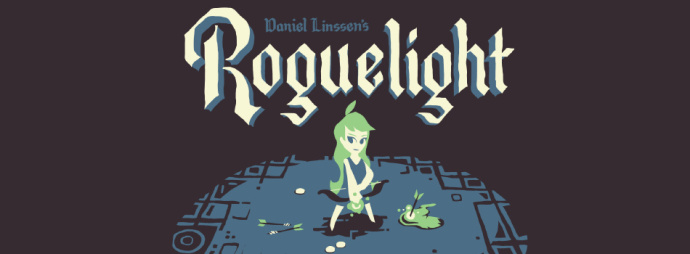
Game Feel and Roguelight

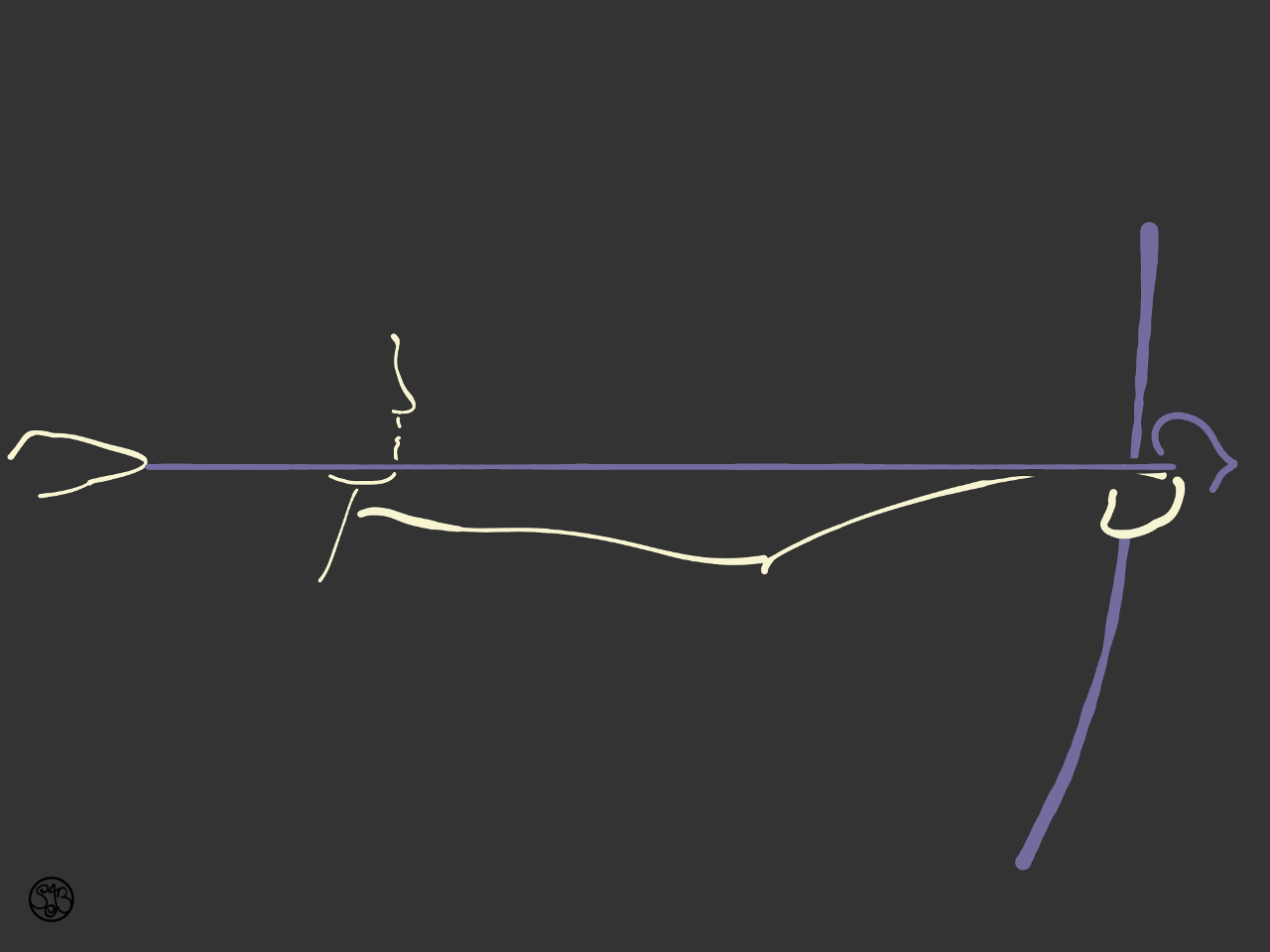
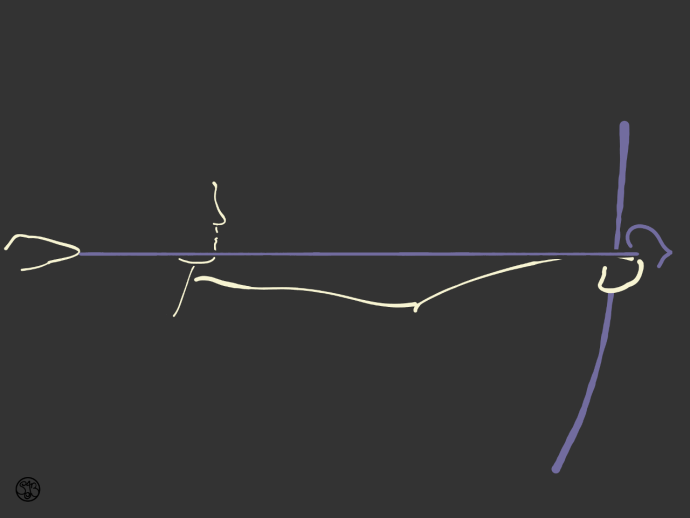
You play her, and you do what she’s doing, which is nocking arrows and treading darkness. It is, as you can guess, of the genre known as roguelite or roguelike or roguelike-like depending on how pedantic you want to be. I have briefly researched the matter and decided I don’t quite care, so: it is a game where you jump around dungeons and kill baddies.

What distinguishes it from its likes is the mingling of offensive and defensive techniques through its use of lighting. Your arrows are both the main light source in the pitch-black dungeons and your sole means of combat, gliding you into an affectionately streamlined game of resource management of health, arrows, level knowledge and visibility. Eventually you run out of arrows and wander blindly through spike pits and ghoulies, promptly die, shop for upgrades, and respawn at the beginning. It is enjoyable to play and that is that.

Which brings me to the other thing I rarely mention: the amorphous and self-explanatory concept of ‘game-feel’. I say self-explanatory but honestly, this term begs for an explanation-no, a justification for its existence. ‘Game-feel’ has the unfortunate fate of being irredeemably wanky-sounding, leading many writers and designers to empty their pockets in pursuit of a suitable alternative. ‘Kinaesthetics’ is often the agreed-upon result, although how that solves the issue of a) clarifying the idea or b) making anyone look less like a shower of bastards is beyond me. Personally, kinaesthetics in relation to videogames seems to speak of the sensation of pushing a button with one’s thumb, which is decidedly not what most people gun for in using it. Instead, what is meant by both ‘kinaesthetics’ and ‘game-feel’ is this: the feeling of a game. It is about as sensible as using ‘food-taste’ to describe the taste of food. Nothing is lost by shortening it to feel.

So, I seldom talk about the feel of a game, largely because such a thing tends to be difficult to talk about despite how crucial it can be to the play experience. Or at least, while we can use gorgeous flowing prose to suggest the fluid feeling of moving through whatever game’s thingamabob, analytical approaches hit a wall when it comes to adapting the same into more technical, drier formats. How a game feels is cursed to lend itself better to demonstration than description.

This was the tact of Jan Willem Nijman of Vlambeer when asked to deliver a talk on ‘game-feel’ (a word he hates, too, and so substituted in ‘screenshake’). In his illustration, Nijman started with the bones of an action game and added decorative elements until it felt sufficiently bombastic—bigger bullets, deeper sound effects, camera recoil—some of which, but not all, invigorated the basic original mechanical aspects by tweaking them to reflect his aesthetic. Despite how Vlambeer is famous for games that are pleasing to play on a base level, Nijman admits he has difficulty articulating what makes a game feel appealing and instead works on intuition.

Fun fact: my own experience of Vlambeer’s shoot-em-up Luftrausers is as follows. First I gorged, and then it repulsed me. I walked away hollow despite the inarguable swish-ness of flying its war-machines. I thought, and I still think, it loved nothing more than the smooth sensation in the instant of play and its vapidity filled me with an emptiness lasting long after that time had passed. Unlike Roguelight something about it just didn’t stick—they’re not the same type of game, I know, but lookit, if the feel of a game is all it takes to make it pleasant, rausing above the lufts shouldn’t now revolt me.

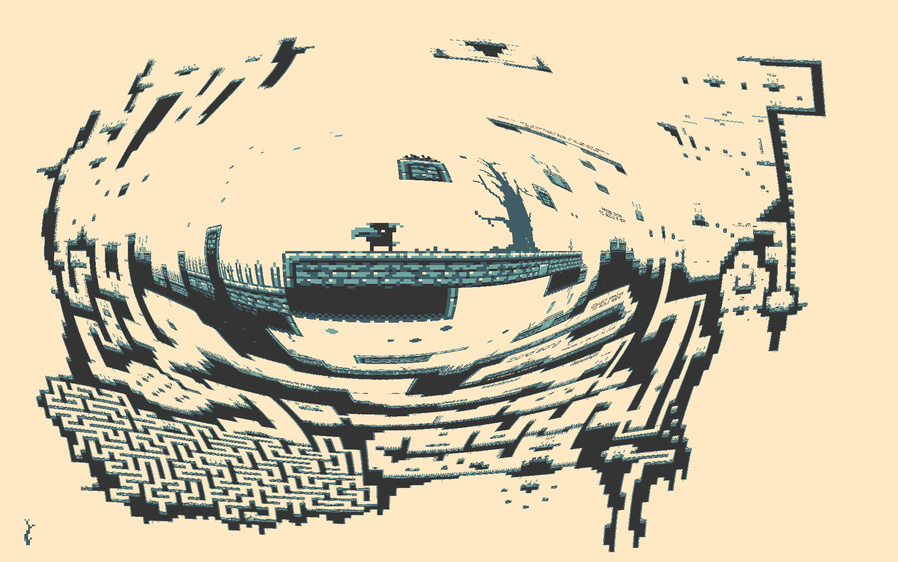
Linssen’s back-catalogue shows he’s an ear for twists on an old formula. Birdsong is a metroidvania-style dungeon-crawler of exploration and backtracking, but sidesteps the need for level memorization by sticking a fisheye lens on the camera to allow the whole map to be shown at all times. It takes a minute but once the concept clicks and you learn how to interpret and benefit from the perspective, it’s a weird and wonderful feeling.
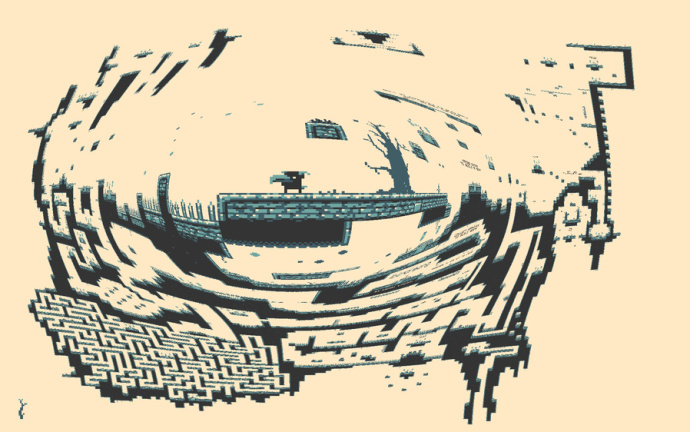
Game Feel and Birdsong

Elsewhere, The Sun and Moon is a traditional platformer—jump; collect the good things; avoid the bad things—whose gimmick is in turning the negative space of terrain into positive space through which players can swim. Javel-ein is an action-platformer restricting you to only one weapon, a javelin to be recovered each time after lobbing it away. Haemo has you painting out the borders of the level by bleeding on them. It’s needlessly frustrating, not one of his strongest games.

For most of the bunch it’s the combination of his little novelties together with the veneer of polish you get from feeling swish to play. His characters move just right, when you press whatever button they flow nicely to where you want them to be. The Sun and Moon is good for this, since moving through terrain feels substantially different to moving through thin air. Each puzzle gives you a twinkle of mastery as you gradually learn to think of it in terms of gravity and buoyancy rather than positive and negative spaces.

And this is why Roguelight is so compelling, why most of Linssen’s games are really enjoyable and clever even for me, who finds jumping to be one of the more stressful modes of videogame transport. Like Vlambeer he taps into some of the more generic types of videogames and morphs their basic mechanics into something enjoyable to play on a surface level. But unlike Vlambeer he carries in his aesthetic the ambition to toy with conventional forms, so welcomes the feel of a game as one of its dramatic components. Lightness and darkness in Roguelight becomes its central tenet rather just a condition of spelunking, distinguishing light and dark as tolerances and affordances. Although we may become blind we’re not necessarily powerless.