Thoughts on nearby covers

Thoughts on some covers - Alien Trilogy

This piece is community funded. If you enjoyed this article, please support my writing by visiting my Patreon and becoming a patron.

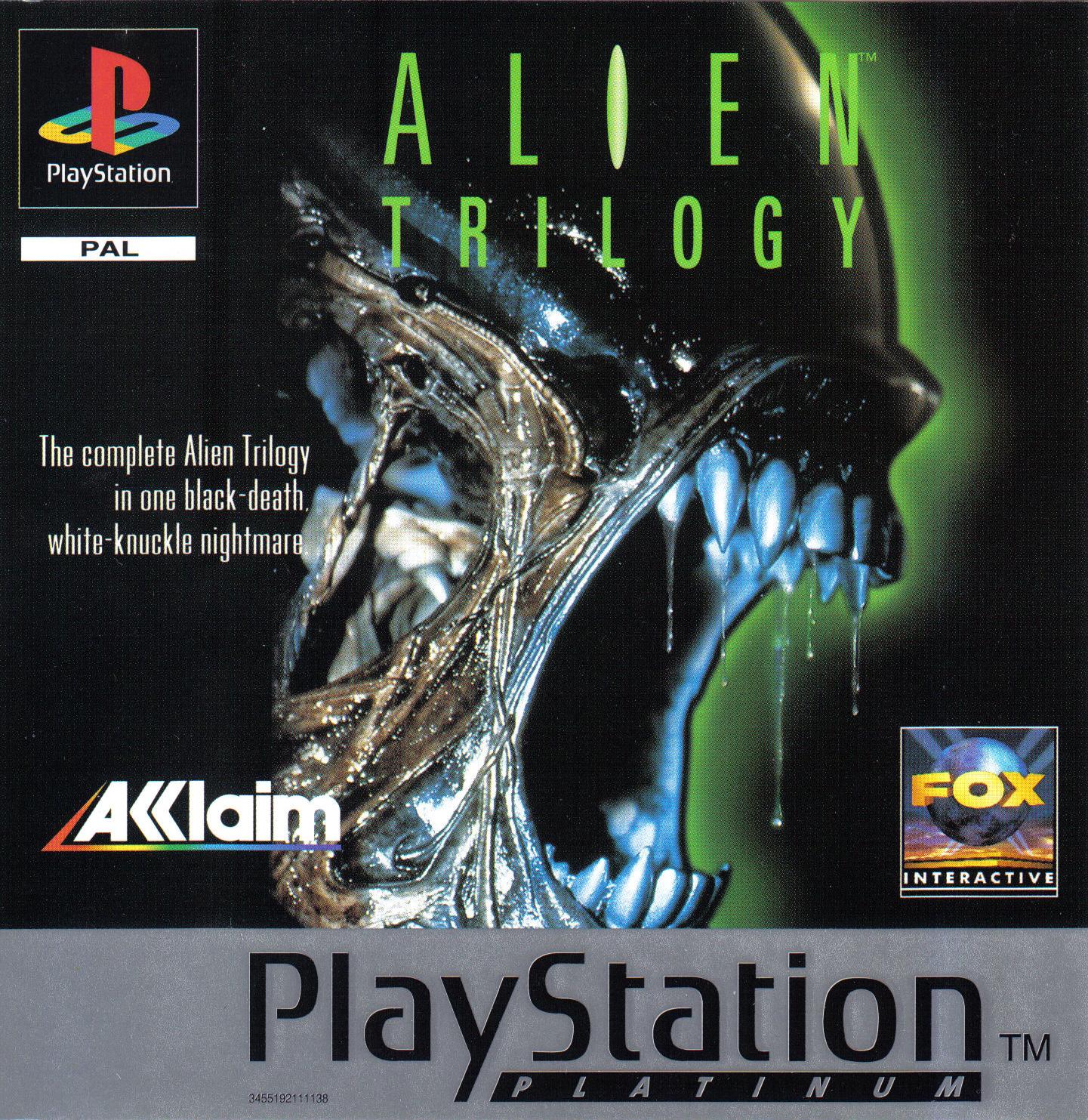
One of my most vivid videogame-related childhood memories is this. In July of 1996, my brother, the middle one, had done our mam no favours by asking for a copy of Alien Trilogy for his birthday. Despite the game having launched four months earlier, which in modern terms would have made it a hundred years old by July, nowhere in our area had any copies in stock. By which I mean, none of the three local video rental shops had it in stock, because this was Ireland at a time when the commercial exchange of games was a novel quirk and not a viable business angle.

Packed into the car were we for a rare trip to The Tallaght Square, famous in our minds for reason number one of being the only remotely accessible shopping centre in the greater Dublin area at a time before Blanchardstown and Liffey Valley. Reason number two for its fame was that it was pyramidal, not square, and this for us, pre-internet, constituted a joke whose humour was always worth revisiting.

So it was immediately a bit of a journey just to find this game, and when we did recover a copy in The Square, it felt all the more of a treasure. I’m sure there were other errands on that trip but my memory tells me it was the only thing we came away with. My brothers and I passed the box around for the long drive home, poring over the manual and delighting in anticipation of what the box cover suggested, foreboding the Alien’s imminent pounce. Once at home we put it on and certainly thrilled in the experience, but now I suspect I didn’t enjoy it half as much I did its prelude.

Perhaps it’s because back then we had fewer games and an over-abundance of free time that we would so patiently gorge on a game’s extra material like aesthetes at an art museum. Now, as I have no lack of the former but absolute lack of the latter, I seldom consciously dwell on a game’s cover as intensely as I used to. While I still variably note my appreciation for or dislike of any given box art, I don’t study what I enjoy about it and savour the anticipation or place it in context, beyond exceptional circumstances. I miss that.

So, with my limited vocabulary, I’d like to take a spell to put that sort of mindfulness to a platoon of games stationed at hand beside me, them dust-coated sentries what have kept me company these past years of working and writing. Continue reading →

On the much hated and woefully overlooked Codec radio

On the much hated and woefully overlooked Codec Radio

This piece is community funded. If you enjoyed this article, please support my writing by visiting my Patreon and becoming a patron.

In a recent video on Persona 3, I talked about how the dating sim-slash-dungeon crawler uses its menus to overlay a certain optimism towards the glacial crisis that was—and still is—complicating the future of Japanese society. This aspect of Persona 3’s menus arises from an assumption I make, and I don’t think it’s too controversial an assumption, about menus existing in games as a mode of introspection.

What do I mean by this?

In an alternate universe I provided a couple of examples to give this interpretation more weight, one example of which was the codec menu in the Metal Gear Solid games. Unlike that marvellous alternate universe, however, time in our universe runs at a rate of one second per second, and to keep the video short and within its scope the example of Metal Gear Solid had to be cut. Instead, I’d like to expand the idea in this article, partly as a complimentary piece to the Persona 3 video, and partly to justify a shabby and safe assumption about videogames that as far as I can tell nobody has contested. Continue reading →

This Week We Read: 09/11/14

Well folks, it’s time for another This Week We Read.

In case you’re new to these, each week I ask a group of peers, colleagues and strangers to share with you between three to five articles they read over the previous seven days. The articles they contribute can be a day old or a year old, they can be highly academic or light as a feather, they can be noteworthy for their originality of perspective or they can be utterly, delightfully derivative – the only criteria is that they found it interesting enough to recommend to you.

In previous weeks this used to be a videogame-centric collaboration insofar as anything contributors linked to had to potentially be at least tangentially of interest to a readership that tends towards the medium of games. My hope in outlining such a loose demand was to encourage people to contribute (and read) outside of our usual tiny corner of the world, in order to advance an interdisciplinary model of game criticism curation.

From this week onwards I’m completely dropping this criteria - now contributors can suggest any piece of text from any field without needing to justify it to videogame-centricism. What I hope to achieve with this is to promote a healthy, outward-looking diet, rather than contributing to an ouroboric critical culture. (I do enough of that in my own writing.)

To this end, I want to emphasise that you don’t need to be a game critic (or a game-anything) to contribute to This Week We Read: we accept guests from any field or discipline.

Contributing this week we have Zolani Stewart, Jess Hyland and Dom Peppiatt. If you’d like to volunteer as a contributor for next week’s post, you can of course contact me on twitter @stbeirne. Now, for articles exploring sculpture as an artform, the self-imposed indie dev caricature, and sound design in Dark Souls, on with the latest This Week We Read.


Zolani Stewart, Canada - Games and Art critic, Founding Editor of The Arcade Review, @Fengxii

Last Week, the Abstract Critical twitter account linked a pdf of the April 1969 Issue of the Metropolitatian Museum of Art Bulletin, and in it is a short and sweet piece of writing on the sculptures and paintings of Jules Olitski. Dissatisfied with the limitations of painting, Olitski used sculpture to explore the foundations of color and surface, and the relationships within color and shape, or what Kenworth Moffett calls “shaped surface.” It’s an engaging read, and a nice gateway for anyone new to criticism on abstract sculpture. And it even helps my own thinking on videogames and their relationship to abstraction and abstract art.

Exteunt Magazine is my current fix for great criticism on theatre and performance art. One of my favourites is Catherine Love’s really expertful review of “An Enemy of The People,” where she explores the show’s own political contradictions, and how they reflect the almost ironic struggle between the intellectual dissatisfaction with capitalist culture and the middle class desires formed by that culture.

At Ricochet, Canada’s newest independent Left publication, Andrea Houston writes a *crucial* piece on the racism that was rampant during Toronto’s Election Campaigns, an issue mostly overshadowed by Jian Ghomeshi’s sexual abuse case.

And lastly, there have been some debates in the black intellectual blogosphere about the term “politically black” and its uses. Here is Nathan Richards arguing caution for the term, claiming that its use has been a tool for non-white non-black scholars to gain credibility in ethnic studies off the backs of black scholars who have less opportunity, and responding is the blog Native Species on how these claims are unfounded, and the assumption of identities trying to climb over others plays into cynical perspectives on identity politics. Obviously I appreciate these kinds of nuanced debates on racial identity/politics that go beyond what I tend to read in the U.S left writing. Here identity is acknowledged as more of a complex, nuanced space than it is a strict grid of identities that operate under strict understandings of how we think power works. It was somewhat refreshing reading it, so I encourage anyone interested to take a look.

Jess Hyland, UK - character artist; @floofyscorp; www.floofyart.co.uk

Cliff Harris’s description of the young, hipstery ‘indie game developer’ stereotype made me squirm a bit, but only because it’s so familiar. He’s raising an interesting point - are indies really as diverse as we like to think they are? Are we missing out on potentially valuable contributors to the indie games space just because they don’t fit the profile, because they aren’t accessible enough?

Have you ever come across a piece of fan-musings that paper over the disappointing elements of a work in a way that just makes you really smile? The total absence of dwarf women in Tolkien’s writings is something that always felt wrong to me, but these fans building their own interesting reasonings for it brightened my day right up.

I’m fairly sure almost everyone on Earth is sick to the back teeth of GamerGate by now, but this long, slightly rambling essay by Film Crit Hulk (which you may want to translate into sentence case with this tool) is heartfelt and somehow brimming with empathy for almost everyone ensnarled in the controversy.

A three-part article by Tim Schneider which is unusual, to me at least, in comparing trends in videogame art to those in fine art. Having never encountered my medium being taken quite so seriously before, I was delighted to read about the debate, both then and now, over the goal of visual fidelity versus aesthetic appeal. History repeats itself, in pixels as in paint.

Dom Peppiatt, England – games journalist - games™, SciFi Now; gamestm.co.uk, @dompeppiatt

John Hopson – a triple-A game design veteran and lead researcher for Bungie – writes about Behavioural Game Design back in 2001: an interesting read when you consider the majority of addictive qualities mentioned have been wrangled to fit into Bungie’s Destiny, over a decade later. A concise and clear breakdown of how developers see their audiences psychologically, and relevant in relation to how Bungie has managed to hook over 9.5 million players on its newest MMO-FPS hybrid.

Nissa Campbell gives a rundown of Red’s personal arc (Transistor) in Finding Her Voice, eloquently deconstructing what it is for a games writer to tinker with self-awareness and metafiction for a protagonist in a game that otherwise plays its narrative straight. Observed with a feminist slant and – if you want to read it a certain way – gaming’s obsession with the power of the phallic icon.

I also happened upon David Canela’s The Sound Of Dark Souls – a reflection on how the sound design/musical direction in From’s seminal action-RPG emphasizes the game’s structure. Describing how a binary musical skeleton and seemingly random rebellions against its own aural rules allows the developer to create an unsetting kind of dread you can’t put your finger on at first. Worth a read for anyone interested in psychogeography, in real or virtual worlds.


That wraps it up for the latest TWWR, folks. Once again, if you’d like to volunteer as a contributor in next week’s post give me a shout on twitter @stbeirne. Thanks for reading and have a good week.



And you with it, speck of dust

And you with it speck of dust

[Endgame spoilers for Demon’s Souls, Dark Souls and Dark Souls 2 to follow.]

As I prepared to sit down and finally write this piece, I did a quick Google search for the key words “Dark Souls” and “nihilism”. I thought I might get one or two hits with the game loosely orbiting the themes of existentialism, since that’s what usually happens when you go looking for specific matches of a game to a theme. But this time was different. The first, I don’t know, ten results wore their investment to the subject matter on their titles: Dark Souls through Sartre and Camus, Kierkegaard and Dark Souls 2, Dark Souls as a nihilistic manifesto.

Well. These are writers who clearly take their jobs seriously, who know what they’re talking about. Just that in itself can be quite daunting—you need a certain level of emotional investment to live up to the standards they’re setting for you as a reader. Maybe you don’t need to know any Camus or Kierkegaard before going in, they’ll explain everything as you’ll need it, but you still have to retain everything they’re throwing at you if you want to satisfy your end of the bargain. And it’s heavy stuff, trying to collapse decades-worth of a fellow’s life work down to a few summary paragraphs, trying to make sense of such a big thing as existentialism at the same time as relating as messy a videogame as Dark Souls.

But sure, it’s not just Dark Souls—every videogame is messy. They’re enormously complicated machines of narrative and function. That they’re often made by so many people, they’re the product of so many different societal factors that smudge and obfuscate and interrelate and form entirely new spheres of interaction. At one of their basest levels they speak languages we’re still puzzling out ways to decode. In a cultural space where half of us are yet figuring our arse from our elbows, officially speaking, as to what, in actuality, a videogame is.

It’s tiring stuff. And true to form, after reading a bunch of these articles, I was wrecked. I felt exhausted even keeping up with the gist of what they were saying. In that, they’re children of the medium, at least. I think there might be a vein in games criticism that values this capacity to affect exhaustion, if only to pay homage to the source. As I typed that out it was a joke, but the longer I stare at it…

You’ve already gathered that I overcame my exhaustion and took to writing my piece. I could say that this was all an allegory for themes of existentialism in Dark Souls, insofar as I stumbled face first into paralysis and dread at the sight of my physical, intellectual and spiritual limitations, but eventually climbed these obstacles and exerted this aspect of myself triumphantly. I could say that, and thematically it would be very nice if it was true. If there are any themes of existentialism in the preceding story, it is only through the accident that I am a person who exists. Which might be enough to prove the point, but since we’re getting into the realm of telling a story about my story, let’s not. Continue reading →

Worldbuilding and Demon’s Souls: Boletaria’s present history

[Spoilers for Demon’s Souls, minor spoilers for Dark Souls.]

Demons souls and worldbuilding: Boletaria's present histor

If I were I to step outside my front door right now and walk twenty paces to my right, I’d find myself opposite the old mill in Celbridge. Over two hundred years ago it used to be the biggest wool manufactory in Ireland, an impressively huge building encapsulated by an enormous stone wall on the roadside. It overlooks the River Liffey, which, if you followed it, would send you all the way to Dublin bay and into the Irish sea, so whenever we go to feed the ducks we’ve a decent chance of locking eyes with the imposing building. Nowadays it’s used as a community centre-it hasn’t been a factory in decades, but it still carries the name as a sign of its history.

Opposite the mill is a pub with a sign in its window proudly declaring it as the establishment where Arthur Guinness brewed his first beer, Celbridge being his hometown. If I step out from my front door and walk left instead of right I’ll come across a statue of the man put up last year. A couple of minutes walking straight past the statue will lead me to Castletown House, Ireland’s biggest and oldest Palladian house, built for the politician William Conolly nearly 300 years ago. Everyone in Celbridge loves to walk their dogs around the mansion’s grounds so it’s pretty much a local fixture, a piece of history written into the normal way of the town’s landscape.

I doubt there’s a town in Ireland where you couldn’t say one thing or another along these same lines. Naas, where I lived for most of my life, derives its name from the Irish Nás na Rí as the place where the old kings of Leinster used to meet. My parents live in Rathangan, a small town wedged between the Slate river and the Grand Canal, owing a lot of its architecture to the tastes of the folk who worked on the latter. I just now found out Jedward grew up in Rathangan, so we have that in common.

Easy as it is to spot the history in Ireland, I’d hazard the same can be said for wherever it is you grew up or wherever you live now, that your locale has a sense of place hinting towards what it might have been, once upon a time. There’s a 600 year old yew in Maynooth where Silken Thomas spent his life’s last night of freedom, but to near everyone who passes it on the way to class everyday it’s just a big fat tree. It’s the kind of thing that’s easy to overlook or that you just internalise without thinking, especially if you were born and raised being told about this or that piece of living history without having the years yet to properly understand it.

So I like seeing this sense of place carried through to worlds in fiction. It helps to make them feel more substantial and more relatable than just being empty places put in to fill a narrative gap, or in the case of most games, a corridor for you to shoot more guys or a side room to stage a lonely chest. It’s especially vital for games dependant on worldbuilding to project this sensation, since their narrative flounders or flourishes on the sensibility and believability of their world design. How a game’s environment’s are designed isn’t only important in terms of them as a playing field, it’s also a huge component of latent narrative design.

I’ve always thought Demon’s Souls was quite good at acknowledging and reflecting this, since it relies heavily on environmental storytelling to add depth to its relatively simple plot. It’s fortunate that the environments demand a fair amount of your attention if you ever want to reach the end of the game-you’ve the fact that they’re laid out kind of like a music sheet where you have to remember locations and types of enemies and recite combat tactics appropriate to the area, and on top of that they’re like puzzles with the importance of discovering and unlocking shortcuts to facilitate your safe passage. Since there’s so much value to poking and prodding every inch to see what it grants you, these aspects give Demon’s Souls‘ environments a great sense of weight. So it’s wonderful that this degree of scrutiny and attention is rewarded by uncovering narrative detail through the game’s organic flow. Continue reading →