Some years ago, my ethics professor put the question to the class, “What does it mean to be Irish?”
I was bewildered. I’d never really left the country, or interacted with foreign or international communities in such a way that provoked me to reflect on my culture in a deliberate, conscious way. When I was growing up my dad had to take medication; I assumed it to be a normal thing that adults do, and that when I got to a certain age I’d have to do the same. You live in this state for so long it seems natural, inseparable from reality. It was the same with being Irish: I simply was Irish, always had been. There was no meaning to it, it just was.
Things are different lately. I’ve been a games critic for some years and I’ve had plenty of exposure to the outside world. I’ve been to countries where it’s warm. Every once in a while, especially around Saint Patrick’s Day, I’ve seen plenty of what it means to be Irish, at least according to other people, mostly Americans. I’ve been made to feet small and inconsiderable, as if the reality of me is irrelevant to their perception of an idea of me. So, because it’s largely not the Irish who command the conversation on what it means to be Irish, here’s me now.
I remember an episode of Johnny Bravo where he went to Ireland. Everything was overly-green (sure how else would you know) even though he never left Dublin. Someone shouted “Get out of that garden” at him, which I later learned was a thing Irish people are thought to say. He probably met a leprechaun. I was very young so it was endearing for the show to even bring him here. The exact same thing happened in Jackie Chan Adventures and The Simpsons and every other show ever made.
RTE used to run an ad for the cartoons they aired. Cartoon Network made these wonderfully edited marvels, so RTE tried their hand at the same. They had this one clip of Spider-Man saying “Irish stew”, over and over. Imagine that, Spider-Man said something about Ireland! It’s like suddenly being recognized by the other kids at school after four years of sitting at the edge of the classroom, which also happened to me.
I’ll be seventy years old and still that image of Spider-Man saying “Irish stew Irish stew Irish stew” will haunt me.
We import a lot of our films and TV shows and games from the UK and the US, so if these are the things you go to for fun it can be hard to find an Irish voice in your media. Kingdoms of Amalur: Reckoning was kind of nice for picking out the accents that seemed authentically Irish. Here was a lovely colourful game with people who sounded kind of like me! That novelty alone gave it some staying power. My patience has long worn thin for the presence of Irish characters in games at large, always derived from the ancient stereotype of a primitive drunken lout.

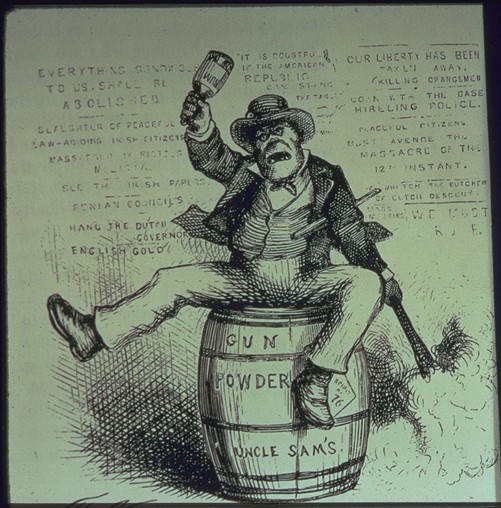
It’s interesting that the caricature born out of sheer prejudicial oppression seems to have been taken up by its victims and internalized to such a point where it’s now considered a habit of pride, within Ireland as without. The reputation of the drunken Irish originated from emigrants who’d discover a taste for the drink as a coping mechanism against a country that didn’t want them there-until only comparatively recently Ireland was fairly moderate for alcohol consumption. It’s also worth noting what has not been exported alongside those prejudices: though we may be up there for alcohol consumption per capita, we’re number three in the world as tea drinkers, two spots above the UK. But tea drinking is seen as culturally sophisticated and clashes with loutishness, so we get internationally characterized as drunks and the Brits are characterised as posh.
So I nearly fell of my chair during BioShock Infinite. A bunch of poor folk are attacking a vending machine, I don’t know why, and one of them shouts “I’M HUNGRY BILL” in an accent I’m told is a brogue. I’ve never known anybody outside of my TV to speak in a brogue. I’ve heard a few stories of people on a visit to the US being told that their accent didn’t sound authentically Irish, which is the anthem of all American impressions of Irish culture.
You’re told from a young age that the country is small and fragile, but wonderful and powerful and great by virtue of its spirit. Oh the Irish have a fantastic reputation for their work ethic, from back when they fled from their occupied homeland and were happy enough to commit to hard work for pittance, so long as they were working. Like the phenomenon of a Saint Patrick’s Day parade, this concept has been reimported and internalized by the Irish people as a point of integrity, which is a nice way of saying we’re expected to toil for nothing. Enda Kenny and Bono and that lot are all for propelling that idiom forward of the laboured, enduring Irish people, as a pat on the head for having strangled us half to death. Still, the only thing we love more than a martyr is seeing ourselves martyred, especially if we can tut about it afterwards.
A joke: an Irish scientist has discovered the cure for begrudgery, but he wont tell anyone it.
Taking the piss out of something that is very serious is a national pastime here, as is moaning. It’s a normal, perfectly acceptable form of communication, born out of a need to cope with the misery that comes with having to live in Ireland. I say that with love. It manifests in exclamations of surprise and betrayal whenever it rains, which is every day. It manifests in how we people from the south remember our history and think about the north only ever in an abstract way, as another country with a separate culture to us, even if that’s completely unfair to the Irish people who live there. Oh thank christ there’s peace, sure haven’t we down here all gotten over that by now, but still, 700 years. The Irish are a fine example of existential absurdity.
I often see other game critics, or journalists really as they’re invariably employed, tilting their noses whenever a controversy lands one of their colleagues in hot water. They’re likely to say something along the lines of, “Oh, why is everyone so negative“, or, “How about being nice instead of criticising what you don’t like.” As if giving out about something is a disdainful thing to be doing with your time, as if you should feign their apathy and smile inanely because, at the end of the day, at least you are videogames. We are all videogames. I’m not sure where this oblivious font of cheerfulness comes from but it’s certainly not native to Ireland. No, ours is a different oblivious font of cheerfulness, the sort that comes out of being culturally bred to resign yourself to the thought of a lifetime of resignation. You tell your jokes and you moan your moan because sure at least you have that measure of control over your life. I’ve enough cultural pride to not stand for any denial of that.
Also not native to Ireland:
1. Lucky charms.
2. Pinching someone for not wearing green on Saint Patrick’s Day.
Saint Paddy’s Day has been exported to the US and reimported back here, and since the time of my youth it’s grown into a plastic grotesquerie, a racist joke about Irish people we honestly laughed at and took home and put on the wall. It’s the one day a year where “everyone is Irish” by virtue of wearing a big green felt hat and acting the maggot. At least, that’s what’s been taken to Dublin City. This year I attended the parade in Celbridge, a decent-sized town one commuting distance outside of the capital. I wore blue and black and got off pinch-free. From all the people I saw, less than half decorated themselves in green. It was a nice, sedate affair. There was a small handful of floats, mostly local businesses and community groups. The Men’s Shed had built a wishing well.
And there was a goat. I took a photo of it.

There wasn’t an epidemic of pinching.
Originally, the whole ‘wearing of the green’ thing came about from the need for hedge schools. I’m probably going to butcher the history a bit so apologies in advance. The teaching of Catholicism was prohibited, so the people used to host discrete masses at the side of the road or in a ditch somewhere. Wherever they could organise it for. They’d wear a spot of shamrock to denote their participation with the religious activity since they couldn’t openly decree their practising of it, the shamrock symbolizing the holy trinity as Saint Patrick used it for. Having shamrock on your lapel was a symbol of solidarity with an underground community, a cultural resistance. So it wouldn’t have made sense for them to wander around cheekily pinching all the Protestants and getting themselves locked up.
The whole pinching thing is an American imagination, as are the voices they say are Irish, as are the characteristics they say are Irish. Even the Irish-American politics that they claim to be Irish are a decades-stagnated version of the politics here. The majority of the Irish people now support gay marriage, so this business of not letting them in the New York parade isn’t on us. Same with the backlash against inviting the PSNI, the Police Service of Northern Ireland. By no means do I speak for all people of the Republic, but near everyone I’ve spoken to has expressed but goodwill towards the north and sorrow at the thought of continued conflict. This notion of us sitting about reciting songs of oppression and making steely-eyed claims about getting the six counties back is an Americanism. It’s as unflattering and alienating of the Irish people as brashly stating that Americans are more Irish than the Irish themselves.
Although it’s nice and all how we’ve a spot in the heart of the US, there’s a fair amount of overwriting I see being done of Irish identities in the way we’re presented and discussed, or rather, in how we’re omitted from the discussion. Irish-American traditions subtly become ‘Irish traditions’, Irish experiences and identities are represented by a certain type of American experiences and identities. Irish heritage is shifted a few thousand miles westward in reference to this heritage. In passing, a couple of hundred years of Irish history are left out of the equation; the current snapshot of Ireland isn’t one of austerity but the same romantic 30-year-old Connemara postcard. The best way for young Irish people to find a job in Ireland is by leaving-Irish games writers have better luck finding work in London than they do here. When industry veterans say you need to be located in a city to work in this business, they don’t mean Dublin or Galway or Cork. Being a young-enough person in Ireland means I’ll never have an opportunity to attend GDC or E3, I’ll never have that option to network and build connections that I’m told is so vital to promoting my brand. I’ll never be able to work locally at the office of a large publication.
Few of these drawbacks are unique to Ireland, as opposed to other, less represented countries. However, this is seldom an issue I see brought up in the discussion of accessibility and diversity of representation in games criticism and journalism. What section of the field that constitutes English-language games criticism is tremendously centralised to a few global hotspots, privileging people with accessibility to these places over those located more remotely. Programs like livestreaming and archiving conferences, and giving speakers the option to pre-record their talks so they can contribute without having to be physically present, such as were available for last Sunday’s Critical Proximity, are vital for the decentralization of gaming’s critical culture.
For our part, at least let us have our moan.
If you liked this article, please consider supporting my writing by visiting my Patreon and becoming a patron.